Instant Arrest Record Lookup
Defendants, Charges, Booking Info, Bond Amount, Case Status, & More
- This Search is Secure and Confidential
- Last updated on October 10, 2026

Arrest Record Reports
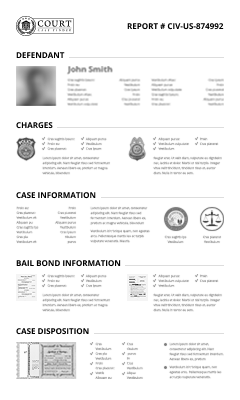
- Person Name
- Date of Birth
- Arrest Date
- Arrest Time
- Arresting Agency
- Arresting Officer
All Arrest Types
- Agency Case Number
- Booking Number
- County
- State
- Charges
- Charge Severity
All Arrest Details
- Bond Type
- Bail / Bond Amount
- Statute / Code Section
- Booking Facility
- Release Date
- Release Type
Providing Instant Arrest Record Reports
for Over 12 Years

Instantly Search Arrest Records & Booking Information Online

View Arrest Details Including Charges, Booking Info, Bond Amounts & More

View & Download Unlimited Comprehensive Arrest Lookup Reports
Arrest Records vs. Incident Report vs. Accident Reports vs. Inmate Records *
Arrest records show when someone has been taken into custody by law enforcement. They serve as an official record of the arrest event, noting basic details from the individual's name to bail and release information. An arrest record does not typically indicate that the person was found guilty; it only confirms that an arrest happened.
Arrest records, incident reports, accident reports, and inmate records, while often grouped under law enforcement records, are distinct record types and serve different legal and administrative purposes. Different agencies maintain each record type. Therefore, knowing the difference can help ensure record seekers obtain the correct information.
Arrest records document when a person was taken into custody by law enforcement. It typically includes the individual's name, date of arrest, alleged charges, basic booking information, and the arresting agency. An arrest record does not indicate guilt or conviction; it only confirms that an arrest occurred.
Incident reports are official narratives created by law enforcement to document events that require a police response. These may involve crimes, disputes, welfare checks, or suspicious activity. An incident report may or may not result in an arrest and typically includes information such as officer observations, witness statements, and descriptive details. Incident reports are investigative in nature and not proof of criminal liability.
Accident reports are specialized incident reports focused on traffic collisions or other accidents. Accident reports include information on involved parties, vehicles, injuries, property damage, and contributing factors. It is frequently used for insurance claims, civil disputes, and safety analysis, and typically does not establish criminal responsibility unless charges are later filed.
Inmate records are created after an arrest has progressed to detention. These records show whether an individual is currently in custody or has been booked into a jail or correctional facility. Inmate records do not include case outcomes; however, they do include information, such as booking dates, housing location, custody status, and release information.
How Arrests Are Generated & Processed
Most arrests begin in one of three ways:
-
First, an officer may witness a crime or develop probable cause during an investigation, thereby permitting an immediate arrest. Probable cause exists when officers have sufficient facts to believe a person has committed a crime.
-
Secondly, an arrest may be made under an active warrant issued by a court, often related to missed court appearances or ongoing investigations.
-
Thirdly, arrests may follow formal complaints or reports, in which evidence gathered over time leads to judicial authorization.
Once probable cause is established, the individual is taken into custody and transported to a police station or detention facility. The booking process commences immediately, which includes verifying identity, recording personal information, documenting the alleged offenses, and assigning a booking or arrest number. This creates the official arrest record. Additionally, law enforcement captures fingerprints and photographs (mugshots) during the booking process.
After booking, several outcomes are possible. The individual may be released on a citation or bond, held in custody pending a court appearance, or transferred to another agency if additional charges are pending. Prosecutors then review the case to decide whether to file formal charges. If charges are approved, the case is entered into the court's docket and assigned a case number.
What Kind of Data is Available in Arrest Records?
Arrest records contain various types of data that provide insight into the circumstances surrounding an arrest, as well as personal and legal details about the individual involved. Here is a breakdown of the key data typically found in arrest records.
Type of Arrest Information |
Details |
|---|---|
Basic Identifying Information |
|
Arrest and Booking Details |
|
Charges and Allegations |
|
Case and Court Information |
|
Fingerprints, Photos, and Biometrics |
|
Bail and Release Details |
|
Sealed or Restricted Information |
|
How to Access Arrest Records
Arrest records can be obtained through online tools and offline requests, depending on where the arrest occurred, how old the record is, and the level of detail needed.
Online Arrest Lookup Options
Many jurisdictions release arrest-related information through online court portals once charges are filed. These systems allow searches by name, case number, or filing dates and usually display basic case details, charges, and docket activity.
Additionally, CourtCaseFinder aggregates arrest, court, and public records data across multiple jurisdictions in a single platform. This is especially helpful for broader searches or when the arresting agency or county is unknown. CourtCaseFinder allows users to search by name and may surface related court cases, charges, and custody status, depending on data availability and jurisdictional rules.
Offline Access
Offline access to arrest records is ideal if the complete arrest reports or certified documents are required. Police department records divisions typically handle arrest reports, while sheriff's offices and detention facilities manage booking and custody records. Older records, sensitive cases, or files not fully digitized may require an in-person visit or a written request by mail.
Identification, Fees, and Processing Times
When accessing arrest records, mainly certified copies, record seekers will typically need to provide proof of identity to verify that they are legally entitled to view the record. This is especially important for sensitive documents, such as those containing personal information or legal matters.
Fees for accessing arrest records vary widely by jurisdiction, record type (basic or certified), and access method (online vs. in-person). Basic record lookups are often free, especially when accessing non-certified records online or through third-party services such as CourtCaseFinder. However, certified copies or requests for more detailed reports may incur charges. For instance,
-
In California, the fees for obtaining arrest records typically range from $25 to $50 for certified copies. Some counties may charge an additional $5 to $10 per page for more detailed requests.
-
In Texas, record seekers may pay around $15 for an online search for arrest records through the Texas Department of Public Safety (DPS). Certified copies may incur an additional $10 fee.
-
The Illinois State Police charges $16 for an online search and an additional $10 to $20 for certified records.
Generally, online searches for arrest records, especially through platforms like CourtCaseFinder, are processed instantly. However, the processing times for arrest records requested in person or by mail vary across jurisdictions. In Texas, requests for certified copies are typically processed within 10 business days. In California, processing can take up to 2 to 3 weeks, depending on the complexity of the search. Likewise, in Illinois, certified copies of arrest records may take 7 to 10 business days to process.
How Far Back Arrest Records Go
Arrest records can date back several decades, but how far back you can access them depends on state law, record-retention policies, and the agency that maintains the data. In many jurisdictions, arrest records can date back several decades, sometimes reaching the early or mid-20th century, provided the documents were never sealed, expunged, or destroyed under retention schedules.
-
Paper vs. Electronic Records: Older arrest records were initially kept in paper, microfilm, or card systems. Most agencies began digitizing arrest and booking data in the late 1980s to the early 2000s, which is why online arrest searches often date back to that period. Arrests that occurred earlier may still exist but usually require a manual or archival request.
-
State and Agency Retention Rules: Retention rules vary widely. Some states require arrest records to be kept indefinitely, while others allow destruction after a set number of years, especially for minor offenses or non-convictions. Records tied to serious felonies are more likely to be preserved long-term.
-
Expunged or Sealed Arrests: If an arrest was sealed or expunged, it may not appear in public searches, even if it occurred recently.
How Long Does It Take to Find Arrest Records
The time required to locate arrest records varies based on record age, jurisdiction, and storage format. Some searches return results almost immediately, while others take significantly longer due to processing and access limits.
Instant Online Searches vs. Manual Requests
Recent arrests typically appear within minutes in online booking logs, jail rosters, or court search systems, sometimes the same day. Older arrests, however, may be stored in archived paper files or legacy databases, requiring staff-assisted searches that can take several days or weeks to complete.
Why Arrest Searches Return Partial Results
Partial results are common when agencies publish only summary-level data online. Detailed arrest reports may require a formal request. Also, differences in name spelling, alias use, or delays between law enforcement and the court system can lead to incomplete search results.
What Slows Arrest Record Searches Down
Arrest record searches take longer when the individual has a common name, when the record spans multiple jurisdictions, or when the case is sealed or expunged. Each factor limits visibility or increases the number of records that record seekers must review manually.
When Arrests Appear in Online Systems
Arrest and booking information usually appears first in jail or sheriff databases. Court records are added later, after charges are reviewed and filed, which may take days or weeks, depending on local procedures and workload.
Why Use CourtCaseFinder for Arrest Records
Searching for arrest records can be time-consuming when information is scattered across local courts, sheriff databases, and county systems. CourtCaseFinder streamlines this process by providing a centralized arrest lookup experience that aggregates publicly available arrest and court data in one place.
One key advantage of CourtCaseFinder is its support for multi-county and cross-state searches. Arrest records are created at the local level, making them difficult to locate when the arrest location is unknown or an individual has lived in multiple jurisdictions.
CourtCaseFinder also reduces the need for in-person courthouse visits or repeated calls to law enforcement agencies. Many arrest-related searches that once required manual requests can now be conducted remotely, saving time, reducing travel expenses, and eliminating administrative delays.
For employers, legal professionals, and researchers, CourtCaseFinder provides faster visibility into arrest history and related case activity. This efficiency is especially valuable for criminal history checks, due diligence, and time-sensitive reviews.
Additionally, CourtCaseFinder helps locate historical arrest records that may not appear readily in standard online searches. While some older records require manual retrieval, the platform helps identify where a record exists and which agency maintains it.
Lastly, CourtCaseFinder helps users confirm whether an arrest record exists and identify the correct jurisdiction before requesting official or certified documents.
Frequently Asked Questions about Finding Arrest Records
Will an arrest record explain what actually happened during the arrest?
No, arrest records typically list charges and booking details. Detailed explanations about what happened during the arrests are typically found in police incident reports.
If charges were dropped, does the arrest record get updated or removed?
In many cases, the arrest record remains visible even if charges were dropped. Complete removal of arrest records typically requires sealing or expungement under state law.
Can I find an arrest record using just a date of birth or an address?
Some systems allow partial searches, but results may be limited. Using a full legal name plus location generally produces the most accurate matches.
How reliable are online arrest lookup websites?
Reliability varies. Reputable platforms like CourtCaseFinder rely on official public data, but accuracy depends on update frequency and reporting delays across jurisdictions.
Are arrest records the same as police arrest logs or daily booking reports?
No. Arrest logs and booking reports show recent activity, while arrest records are formal documents that may later link to court cases and outcomes.
How long do arrest records stay visible online?
Arrest records typically remain visible indefinitely unless they are sealed, expunged, or restricted by law.
Can an arrest record be removed if there was no conviction?
In some states, yes. Individuals may request expungement or sealing if eligibility requirements are met, but removal is not automatic.
Do arrest records show bail or bond amounts?
Often they do. Bail or bond information may appear in booking details or be added after the court processes the case.
Are federal arrest records searched differently from state or local arrests?
Yes. Federal arrests are handled through federal courts and agencies, and they do not always appear in state or county databases.
Do arrest records include warrants or probation details?
Typically no. Warrants and probation information are maintained in separate court or law enforcement systems.
Are arrest records public for non-citizens or immigration-related arrests?
General arrest records may be public, but immigration-related detentions typically fall under federal jurisdiction and follow different access rules.
What should I do if I find incorrect information in an arrest record?
You can contact the arresting agency or court clerk to request a correction. Supporting documentation is usually required.
Do arrest records show if a case was dismissed or expunged?
Some do, especially if the court has updated the record. Expunged or sealed cases may no longer appear in public searches.
Can I search arrest records using only a mugshot?
Most official databases do not support mugshot-only searches. Mugshots are typically linked to names or booking numbers.
Is there a record if someone was arrested but never taken to jail?
Yes. An arrest record can exist even without a jail booking, especially if the individual was cited and released at the scene.