Instant Criminal Record Lookup
Defendants, Charges, Booking Info, Case Status, Sentencing, & More
- This Search is Secure and Confidential
- Last updated on October 11, 2026

Criminal Record Reports
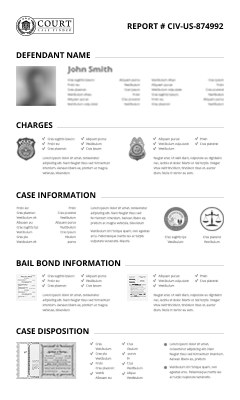
- Subject Name
- Date of Birth
- County
- State
- Case Number
- Case Status
All Criminal Record Types
- Court Name
- Case Type
- Charges
- Charge Description
- Filing Date
- Arrest Date
All Criminal Record Details
- Case Disposition
- Disposition Date
- Judge
- Sentencing Details
- Incarceration Details
- Probation / Parole Status
Providing Instant Criminal Court Case Records
for Over 12 Years

Instantly Search Criminal Records & Booking Information Online

View Criminal Record Details Including Charges, Booking Info, Case Status & More

View & Download Unlimited Comprehensive Criminal Record Reports
Criminal Records vs. Arrest Records vs. Court Records *
Criminal records document a person's history with the criminal justice system after an arrest. They typically include information from charges to case outcomes. Understanding criminal records helps clarify how they differ from arrest or court records and how they are used for criminal history checks, legal research, and compliance purposes.
Although criminal records, arrest records, and court records are used interchangeably, they describe distinct categories of information, each serving a specific purpose and offering a different level of detail.
-
Criminal records summarize a person's involvement in criminal cases and the outcomes of those cases. They typically indicate whether formal charges were filed and how the matter was resolved. This may include convictions, dismissals, acquittals, deferred judgments, or plea agreements. Criminal records focus on final case outcomes rather than every procedural step and are typically maintained by the courts or state-level criminal history repositories.
-
Arrest records, by contrast, document interactions with law enforcement rather than with the courts. An arrest record shows that a person was taken into custody and usually includes the date of arrest, the arresting agency, and the alleged offense. An arrest does not establish guilt, as charges may never be filed, or the case may later be dismissed. As a result, arrest records may exist even when no criminal case proceeds to trial.
-
Court records provide the most comprehensive view of a legal case. They include all documents filed and actions taken during court proceedings, such as complaints, charging documents, motions, hearing dates, docket entries, judgments, and sentencing orders. Maintained by the courts where the case was heard, court records offer a detailed procedural history rather than a summary outcome.
These records are not equivalent; rather, they complement one another, reflecting different stages of the legal process.
How Criminal Cases Are Generated & Processed
While procedures vary by jurisdiction, most cases follow the same core stages from investigation to resolution.
Investigation and Arrest
The process usually begins with an investigation. Law enforcement agencies respond to reports of criminal activity or initiate inquiries based on observed conduct or received information. Officers collect evidence, interview witnesses, and evaluate whether probable cause exists to believe that a crime has occurred.
When probable cause is established, law enforcement may make an arrest or issue a citation, which creates an initial arrest record but does not, by itself, start a formal criminal case.
Charging Decisions
After an arrest or the completion of an investigation, the case is reviewed by the prosecuting authority, such as a district attorney or state attorney. Prosecutors evaluate the evidence to determine whether to file formal criminal charges, which charges, if any, are appropriate, or to decline the case. Charges may be filed immediately, amended later, or dismissed if the evidence does not meet legal standards.
Court Proceedings
Once charges are filed, the case enters the court system. This phase typically begins with an initial appearance or arraignment, where the defendant is informed of the charges and enters a plea. The case may then proceed through pretrial hearings, motions, and review of the evidence. While some cases may go to trial, many are resolved through negotiated plea agreements.
Case Resolution
Case resolution occurs when the matter is dismissed, resolved by a plea, or decided at trial through conviction or acquittal. In some situations, diversion programs allow eligible defendants to complete conditions in exchange for avoiding a conviction.
Sentencing and Post-Conviction Updates
If convicted, the court may impose a sentence that includes incarceration, probation, fines, restitution, or participation in treatment programs. Post-conviction updates, such as appeals, sentence modifications, or probation completion, may later affect how the case appears in criminal records. The outcomes are recorded in court records, indicating how the case was concluded.
What Kind of Data is Available in Criminal Records?
The type of information available in criminal records may vary based on the jurisdiction, the stage of the case, and whether portions of the record have been restricted by law or court order. Data typically available in criminal records includes identifying details, case and charge information, case outcomes, and sentencing terms when applicable.
The table below outlines the most common categories of data in criminal records, what is typically included in each record, and whether the data are publicly accessible.
Data Category |
Typically Included |
Publicly Accessible |
Notes |
|---|---|---|---|
Personal Identifiers |
Name, aliases, DOB (partial) |
Often |
Full identifiers may be limited |
Case & Charges |
Charges, statutes, case number |
Yes |
Core case information |
Case Outcomes |
Conviction, dismissal, acquittal |
Often |
Diversion outcomes vary |
Sentencing |
Jail, probation, fines |
Often |
May update over time |
Juvenile Records |
Case details |
No |
Confidential by law |
Sealed/Expunged Records |
Limited or none |
No |
Access is restricted by the court |
How to Access Criminal Records
Access to criminal records depends on where the case was handled, how old the record is, and the level of detail requested.
Online Criminal Records Lookup Options
Many courts offer online case search systems at the county or state level. These portals usually allow searches by name, case number, or filing date and may display charges, docket activity, and case outcomes. State criminal history repositories, typically operated by state police or justice departments, offer name- or fingerprint-based searches for more detailed records.
Third-party public record search platforms compile data from multiple sources; however, the accuracy of results depends on how frequently the data is updated.
Offline Access
For certified or official copies, offline access is usually required. Clerk of court offices maintain original criminal case files and can provide copies on request. State police or justice department record units may also handle requests for statewide criminal history reports, which may require in-person or mail submissions.
Identification, Fees, and Processing Times
Accessing certified copies of criminal records typically requires presenting valid government-issued identification, such as a driver's license or passport, and, in some cases, providing fingerprints, particularly for comprehensive history reports.
Fees are set by the state criminal repository or the court, and processing times vary widely by jurisdiction. For example:
-
California: Individuals may submit fingerprint images and pay a $25 processing fee. Fingerprinting services typically charge an additional operator fee, bringing the total costs to between $45 and $75, depending on the location. Processing times depend on fingerprint submission and DOJ workload.
-
Texas: A name-based criminal history record check costs approximately $10, with an additional fee for fingerprint services. It takes about 10 business days to process criminal history record requests in Texas.
-
New York: A statewide criminal history record search costs about $95 per name and date of birth. Online requests are typically processed within a few hours, while mail requests usually take up to 3 weeks, depending on submission and mailing times.
How Far Back Criminal Records Go
The duration for which criminal records remain accessible varies widely depending on state law, record type, and local retention practices.
Felony convictions are typically retained permanently in most states, while misdemeanor records may be subject to shorter retention periods or eligibility for sealing or expungement. For example:
-
In California, non-conviction records older than one year may be restricted from public access.
-
Texas maintains most felony and misdemeanor records indefinitely for authorized use.
-
In New York, felony convictions are permanent, whereas some misdemeanor and violation records can be sealed under specific conditions.
Retention also depends on whether the record resulted in a conviction or was dismissed; many states limit public access to non-conviction cases after a set period.
Older criminal records may exist only in paper or microfilm form, making them harder to access and requiring manual retrieval from court archives. In contrast, modern digital records are more easily searchable and accessible online.
How Long It Takes to Find Criminal Records
The time required to locate criminal records depends on the jurisdiction, the age of the case, and the method of access. Recent cases fully indexed in online courts or state portals can be retrieved within minutes, providing instant access.
Older cases, archived records, or those not yet digitized require manual review through court clerks or record offices. These searches may take several business days or longer, depending on storage methods and the court's workload.
Partial results are common when historical records have not been fully digitized or when online systems display only summary docket information. Searches may also be delayed by common names, cases filed across multiple jurisdictions, or recently filed matters that have not yet been updated in public databases. In such cases, follow-up or direct court contact may be necessary.
Why Use CourtCaseFinder for Criminal Records
Searching for criminal records can be challenging because cases are maintained by thousands of local courts and state agencies, each with its own systems and access rules. CourtCaseFinder helps simplify this fragmented process by providing a more efficient way to locate criminal case information across jurisdictions.
One key advantage is centralized search capability. Because criminal cases are filed locally, records may exist in multiple counties or states. CourtCaseFinder supports broader searches that help identify potential records even when the exact filing location is unknown, reducing the risk of incomplete results.
CourtCaseFinder also helps users avoid navigating multiple court and agency portals. Instead of switching between websites with varying formats and limitations, users can rely on a single, consistent search experience that saves time and minimizes confusion.
For professionals such as employers, legal practitioners, and compliance teams, faster preliminary verification is valuable. CourtCaseFinder allows users to quickly determine whether criminal cases may exist and where they are held.
Finally, the platform supports pre-request confirmation, helping users verify records before submitting official or certified requests, reducing unnecessary fees and administrative delays.
Frequently Asked Questions about Finding Criminal Records
Can I search criminal records using only a name, without a date of birth?
Yes, many systems permit name-only searches, but the results may be incomplete or contain multiple matches. A date of birth helps distinguish individuals with common names.
Do criminal records include traffic violations or infractions?
Serious traffic offenses, such as DUIs, typically appear in criminal records. However, minor traffic infractions are typically handled separately and are not included in criminal records.
Can I find federal criminal records the same way as state or county records?
No, federal criminal records are maintained in separate federal court systems and are not usually included in state or county searches.
Are criminal records updated automatically when a case is dismissed or expunged?
The frequency of updates depends on the court and data source. Some systems update promptly, while others may show delays or require manual review.
Can someone see who searched for their criminal record?
Public court searches are generally anonymous and do not notify the individuals being searched.
Do criminal records show warrants or pending charges?
Criminal records may show pending cases, but active warrants are generally maintained separately by law enforcement.
How accurate are online criminal record search results?
The accuracy of online criminal record searches varies by source, update frequency, and jurisdiction. Official court records are the most reliable.
Can criminal records be accessed for people who have changed their names?
Yes, records may still exist under prior names, especially if aliases are linked in the record, though searches may require additional identifiers.
Do criminal records include probation or parole violations?
Some criminal records may reflect probation or parole violations if they resulted in court action.
Can criminal records be accessed internationally or used outside the U.S.?
Access to criminal records is generally limited to U.S. jurisdictions, though records may be requested for international legal or immigration purposes.
Are mugshots part of criminal records?
Mugshots are typically law enforcement records and may not appear in court-only criminal records.
What is the difference between a statewide criminal history and a court criminal record?
A statewide criminal history aggregates data from multiple sources, while a court record reflects details from a specific case.
Can criminal records be removed from private websites even if they are public?
Some sites allow removal requests, but public court records themselves remain unless sealed or expunged.
Do criminal records include cases that are still under investigation?
No, investigations without filed charges are not part of criminal court records. Records generally begin once charges are filed.
Is it legal to use criminal records for personal reasons, such as dating or neighbor checks?
Accessing public records is legal, but using them for housing, employment, or credit decisions is subject to legal regulation.