Instant Driving Violation Lookup
Defendant, Issuing Officer, Violation Type, Fine Amount, Case Status, & More
- This Search is Secure and Confidential
- Last updated on October 10, 2026
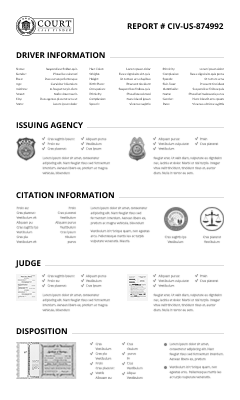
Driving Violation Records
- Driver Name
- Date of Birth
- License Number
- License State
- License Status
All Violation Types
- Violation Date
- Violation Location
- Violation Type
- Issuing Agency / Officer
- Citation Number
All Violation Details
- Fine Amount
- Points Assessed
- Statute / Code Section
- Court Name
- Court Date
Providing Instant Driving Violation Reports
for Over 12 Years

Instantly Search Full Driving Violation Information Online

View Driving Violation Info Including Defendant, Issuing Officer, Violation Date, Status, & More

View & Download Unlimited Comprehensive Driving Violation Court Reports
Driving Violations vs. Traffic Tickets vs. Criminal Traffic Offenses vs. Driving Records *
Driving violations are offenses related to the operation of a vehicle and involve breaking traffic laws or regulations. They can range from minor infractions to more serious violations that carry higher penalties. Knowledge of driving violations helps explain how tickets are issued, how violations are recorded, and how they may affect a driver's record, fines, or driving privileges.
Driving violations, traffic tickets, criminal traffic offenses, and driving records are related concepts within traffic law, but they describe different levels of conduct, legal consequences, and documentation.
Driving violations refer to breaches of traffic laws or motor vehicle regulations that have been formally addressed through the legal or administrative system. These violations may range from minor issues, such as a broken taillight and speeding, to serious offenses, such as failure to yield or running a red light.
Once a violation is resolved, whether by paying a fine, completing traffic school, or receiving a court judgment, it may be reported to the court, the state Department of Motor Vehicles (DMV), or both. Reporting practices vary by state, which affects how long a violation appears on a record.
Traffic tickets, also called citations, are the initial notices issued by law enforcement alleging a violation of the law. A ticket begins the legal process but does not establish guilt on its own. Drivers are typically given options, such as paying a fine, contesting the citation in court, or completing traffic school where permitted.
The outcome determines whether the ticket results in a recorded violation or is dismissed.
Criminal traffic offenses involve more serious driving behavior that poses a higher risk to public safety. Offenses such as driving under the influence, reckless driving, hit-and-run, or vehicular assault are prosecuted in criminal court.
These cases may result in criminal convictions, incarceration, probation, license suspension or revocation, and lasting impacts on both criminal and driving records.
Driving records, also known as motor vehicle records, are administrative summaries maintained by state DMVs. They track a driver's license status, reported violations, points, suspensions, and revocations. Driving records do not always include detailed court proceedings, which distinguishes them from criminal or traffic court files.
How Driving Violation Cases Are Generated & Processed
Driving violation cases are generated and processed through a structured legal and administrative system designed to enforce traffic laws and promote roadway safety. Although procedures vary by state, most cases follow a similar progression from enforcement through resolution to recordkeeping.
-
The process usually begins with enforcement. A violation may be identified during a traffic stop by a law enforcement officer or through automated systems, such as red-light or speed cameras.
-
In both situations, a citation is issued, either handed directly to the driver or mailed to the registered vehicle owner, formally alleging a violation of traffic law.
-
After a citation is issued, the driver must respond within a required timeframe. Response options typically include paying the fine, which generally resolves the matter without court involvement, or contesting the citation by requesting a hearing.
-
Some jurisdictions allow alternatives, such as traffic school or deferred disposition for eligible drivers. Failing to respond may lead to additional fines, late fees, or administrative penalties, including license suspension.
-
If a driver contests the citation, the case proceeds to traffic court. During the court proceeding, the driver may enter a plea, present evidence, question witnesses, or negotiate a resolution.
-
Depending on the jurisdiction and the nature of the violation, the case may be resolved through a formal hearing, a trial, or an administrative review.
-
Case resolution may result in dismissal, a finding of responsibility, reduced charges, or completion of a diversion program.
-
Finally, court outcomes are reported to the DMV, which updates the driver's record, assesses points, and determines any license-related actions that affect driving privileges.
What Kind of Data is Available in Driving Violation Records?
The information available in driving violation records varies by jurisdiction, the seriousness of the offense, and the manner with which the case was resolved. Records commonly include the driver's identification, details of the cited violation, and the outcome of the case. Many also reflect penalties, such as fines, points, or license actions.
However, specific categories, including juvenile matters and restricted cases, may be subject to partial or complete restrictions on public access, as summarized in the table below.
Data Category |
Typically Included |
Publicly Accessible |
Notes |
|---|---|---|---|
Driver Identifiers |
Name, license number (partial), DOB |
Often |
Full identifiers may be restricted |
Violation Details |
Offense, statute, date, location |
Yes |
Core citation information |
Case Outcome |
Paid, dismissed, convicted, deferred |
Often |
Updates may lag |
Penalties |
Fines, points, restrictions |
Often |
DMV actions may appear separately |
Restricted Records |
Juvenile or sealed cases |
No |
Access is limited by law |
Camera Violations |
Automated enforcement data |
Varies |
Rules differ by state |
How to Access Driving Violation Records
Accessing driving violation records depends on whether the information is maintained by the court, the state DMV, or both. Traffic violations typically generate parallel records: one in the court that handled the citation and another in the DMV, which maintains the driver's official history.
Online Criminal Records Lookup Options
Many states provide online portals through the DMV or Motor Vehicle Record (MVR) systems. These platforms allow drivers or authorized parties to request a summary of violations, points, license status, and suspensions, though they may not include full court documents.
Traffic and municipal courts usually maintain separate case search systems. Users may search by name, case number, or ticket number to view case status, hearing dates, and outcomes. Some portals also provide scanned court documents.
Third-party search tools aggregate data from multiple jurisdictions, helping users locate records when the issuing court or state is unknown. However, coverage and update frequency may vary.
Offline Access
Access to certified official records usually requires offline requests. DMV offices may issue certified driving records or abstracts, usually by appointment, while court clerks may provide copies of citation files, judgments, or proof of compliance. Offline access is typically provided by mail-in or walk-in.
Identification, Fees, and Processing Times
When requesting driving violation records, agencies typically require government-issued identification, such as a state ID, and, in some cases, written authorization from the driver if the documents pertain to another person.
Fees and processing times vary by state and by request method: online, in person, or by mail. For example:
-
California: An online uncertified copy of a driving record costs $2 and can be printed immediately after payment on the California DMV website. Mail- or walk-in requests for certified copies cost $5 per record and may take up to 4 weeks to process.
-
Texas: Record seekers can access driving violation records from the Texas Department of Public Safety. Online certified driving record requests cost $2 and can be printed immediately after payment. Mail and in-person requests for certified records (Type AR) cost $20 and generally take about 3 weeks to process and return.
-
New York: Ordering a driving record online costs $7 and is typically available for immediate viewing and printing, while an in-office request costs about $10. Requests made through the MyDMV Navigator may take about 5 business days to process.
How Far Back Driving Violation Records Go
The length of time driving violation records remain available varies by state, violation type, and whether the record is maintained by the court or the DMV. There is no national retention standard, and visibility can differ significantly depending on the record source.
States commonly retain moving violations, such as speeding or failure to yield, on DMV driving records for a set number of years, usually between three and seven, particularly when points or insurance consequences are involved. Non-moving violations, including parking or equipment issues, are less likely to appear on long-term driving records and may be removed more quickly.
More serious traffic offenses classified as misdemeanors, such as DUI or reckless driving, are typically retained for much longer. In many states, these violations remain on criminal or court records indefinitely, even if they are removed from the DMV record after a predetermined period.
Courts and DMVs follow different retention schedules. While DMVs periodically clear older violations for licensing purposes, courts usually keep traffic case files for many years or permanently in archival form. Accordingly, older violations may remain in court records even when they no longer appear on a driving record.
How Long It Takes to Find Driving Violation Records
The time needed to locate driving violation records depends on where the records are maintained, how recent the violation is, and the method of access. Many drivers may obtain results quickly, while older or certified records require additional processing.
Recent violations are typically available the same day through DMV or MVR portals once the court reports the case outcomes. These systems typically update on a scheduled cycle rather than in real time. In contrast, requests submitted directly to traffic courts, particularly for archived cases or certified documents, may take several business days to a few weeks, depending on the court's workload.
Partial results are common due to reporting delays between courts and DMVs or because some online systems display only summary information. Searches may also be slowed by out-of-state violations, common names, or incorrect license details, all of which may require review to confirm accurate results.
Why Use CourtCaseFinder for Driving Violation Lookup
Locating driving violation records may be challenging because citations are processed by local courts, while driving histories are maintained separately by state DMVs. CourtCaseFinder simplifies this process by providing a more efficient way to find driving violation information across jurisdictions.
-
CourtCaseFinder provides users with a centralized search service. Driving violations are issued at the local level, and records may exist in multiple counties or states if a driver has moved or traveled. CourtCaseFinder supports broader searches across courts, reducing the risk of missed records, especially when the issuing jurisdiction is unknown.
-
CourtCaseFinder also helps users avoid navigating different DMV and court portals. Each jurisdiction has its own rules and access limitations, which can slow searches and cause confusion. Using a single search tool simplifies the process and saves time.
-
For insurance providers, employers, and licensing authorities, faster preliminary verification is crucial. CourtCaseFinder enables quicker identification of citations and case outcomes that may affect underwriting, hiring, or compliance decisions.
-
Lastly, CourtCaseFinder supports pre-request verification, allowing users to confirm records before submitting certified DMV or court requests, reducing unnecessary fees and administrative delays.
Frequently Asked Questions about Finding Driving Violation Records
Can I search driving violation records using only a license plate number?
In some jurisdictions, license plate searches are permitted through court or law enforcement systems, but public access is usually limited, and most searches require a name or driver's license number.
Do out-of-state driving violations appear on my home state driving record?
Many states share violation data through interstate compacts. Therefore, out-of-state tickets may be reported to your home state's motor vehicle agency.
Are parking tickets included in driving violation records?
Parking tickets are usually administrative citations and typically do not appear on official driving records unless they remain unpaid and are escalated to the court system.
Can driving violations appear on criminal history checks?
Most routine traffic violations do not appear on criminal history checks, but serious offenses, such as DUI or reckless driving, may.
How soon after a ticket is issued does it appear on a driving record?
Violations typically appear on a driving record after the court resolves the case and reports the outcome to the motor vehicle agency, a process that may take days to weeks.
Do traffic camera tickets affect driving records the same way as officer-issued tickets?
Automated camera citations usually carry different reporting rules and may not always result in license points.
Can driving violations be removed early from a driving record?
Some states permit early removal upon completion of traffic school or participation in deferred-disposition programs.
Do employers need my permission to access my driving record?
Yes, employers must generally obtain written consent before requesting a driving record.
Are commercial driver (CDL) violations reported differently than non-CDL violations?
Yes, CDL violations are tracked more strictly and are usually reported at the federal level in addition to state systems.
Can driving violations be transferred or merged if I change states?
When you move, prior violations may be shared with the new state, but how they are recorded depends on state law and interstate agreements.