Instant Divorce Case Lookup
Petitioner, Respondent, File Date, Case Number, Judge, & More
- This Search is Secure and Confidential
- Last updated on October 10, 2026

Divorce Case Reports
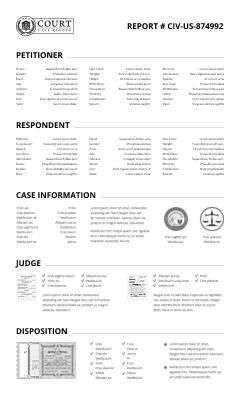
- Petitioner Name
- Respondent Name
- County
- State
- File Date
All Divorce Types
- Case Number
- Judge
- Disposition
- Disposition Date
- Return Date
All Case Details
- Petitioner Attorney
- Petitioner Attorney Address
- Respondent Attorney
- Respondent Attorney Address
Providing Instant Divorce Court Case Records
for Over 12 Years

Instantly Search Full Divorce Court Case Information Online

View Divorce Filing Info Including Parties' Attorneys, Judges, Dispositions & More

View & Download Unlimited Comprehensive Divorce Court Case Reports
Divorce Case vs. Divorce Decree vs. Divorce Record *
Divorce records are official documents created during and after the legal dissolution of a marriage. They confirm that a divorce occurred and may include basic case details and the court that handled the case.
When individuals search for information about a divorce, they typically encounter the terms "divorce case", "divorce decree", and "divorce record". While these terms are related, they refer to different parts of the divorce process. Knowing how they differ helps ensure you request the correct document for your specific need.
A divorce case is the entire legal proceeding filed with a court to end a marriage. It begins when one spouse submits a divorce petition and continues through hearings, motions, and negotiations. The case includes all procedural activity, such as court motions, responses from each party, and docket updates. A divorce case may still be ongoing, dismissed, or completed, depending on its stage in the court process.
A divorce decree is the final judgment issued by the court that officially dissolves the marriage. A divorce decree, signed by a judge at the conclusion of the case, sets the legally binding terms of the divorce, including property division, spousal support, child custody, and child support, where applicable. This document serves as formal proof that the divorce is final. Divorce decrees are typically required for remarriage, to enforce court orders, or to update legal records.
A divorce record is a broader category that can refer either to the public portions of a divorce case file or to a summary document maintained by a state agency. This may include the divorce decree, a divorce certificate, docket entries, or case summaries. In some states, divorce records include certificates or verifications that confirm a divorce occurred but do not list detailed terms. These records are commonly used for administrative purposes such as identity verification, criminal checks, or research.
How Divorce Cases Are Generated and Processed
Divorce cases go through a defined legal process that begins with a formal court filing and ends with a final judgment dissolving the marriage. While specific procedures differ by state, the overall structure is similar nationwide.
A divorce typically begins when one spouse files a petition or complaint for divorce with the appropriate court, usually in the county where either spouse resides. The petitioner must provide basic information about the marriage, residency, and legal grounds, along with the required filing fees. Filing the case officially opens the case, assigns a case number, and records the matter into the court's record system.
After the case is opened, the filing spouse must legally notify the other party through service of process. State rules govern how service is completed, commonly through a sheriff, professional process server, or certified mail. Once served, the responding spouse is given a set period to file an answer. If no response is submitted, the court may move forward under default procedures.
As the case progresses, courts oversee motions, disclosure, and hearings. Parties may be required to submit financial information, asset lists, or parenting plans. Many jurisdictions also require mediation or settlement efforts before a case proceeds to trial. Each action is logged on the court docket, creating a chronological record of the case.
A divorce case concludes either through a negotiated agreement, as in an uncontested divorce, or a judge's ruling after hearings or trials in contested divorces. The final step is the issuance of a divorce decree, which legally ends the marriage and establishes binding terms, including property division, support, and custody. Throughout this process, courts generate records that may become publicly accessible after finalization, subject to redaction or sealing rules, depending on the case and jurisdiction.
What Kind of Data is Available in Divorce Records?
Divorce records contain different types of information depending on the jurisdiction, the stage of the case, and whether portions are sealed or restricted. Knowing what data is included can help determine if a record meets legal, personal, or research needs.
Types of Divorce Information |
Details |
|---|---|
Basic Identifying Information |
|
Case and Docket Details |
|
Marital Outcomes and Final Judgments |
|
Financial and Property Information |
|
Child Custody and Support Data |
|
Sealed or Redacted Information |
|
How to Access Divorce Records
Divorce records are maintained primarily at the county court level, with some states offering limited access through vital records offices. Access depends on factors such as jurisdiction, the age of the case, and the type of record requested. Knowing the available methods for obtaining these records can help simplify the search and ensure accurate results.
Online Access
Many states and counties provide online portals for searching divorce records by party name, case number, or filing year. These portals typically allow users to search basic docket information by the names of the parties, case numbers, or filing dates. Some jurisdictions allow access to scanned copies of public documents, such as final judgments.
Some state vital records offices may allow online requests for divorce certificates or verifications. However, these confirm that a divorce took place but typically do not include detailed terms.
Additionally, third-party public records platforms also aggregate court data and may provide access to divorce records. However, the completeness and accuracy of the information depend on the source and how frequently the database is updated.
Offline Access
For certified or complete documents, offline requests are required. The county court clerk where the divorce was finalized holds the official case files and divorce decrees. Requests can be made in person, by mail, or via submitted forms, depending on the court. State or county vital records offices may also provide divorce certificates, especially for older cases or where permitted by law.
Identification, Fees, and Processing Times
Requesting divorce records usually requires proof of identity and payment of applicable fees, which vary by state and sometimes by county. In many jurisdictions, basic case details, such as party names, filing dates, and case numbers, may be available online or at no cost through court portals. However, obtaining official or certified copies typically involves additional fees and processing times.
For example, California generally charges around $15-$20 per copy for a certified divorce decree when requested through the county clerk or court. Texas often charges $10-$25, depending on whether the record is requested online, by mail, or in person. In Florida, fees commonly range from $5 to $15, with extra charges for certification or expedited service. Likewise, in New York, divorce certificates requested through the state typically cost about $30.
Processing times also vary. Online access to recent cases may be immediate, while certified copies may take several business days to a few weeks, especially for older or archived records. For instance, mail requests for a certified copy of a divorce decree in California take between 2 and 4 weeks, depending on the county workload. In Texas, processing times commonly range from 5 to 15 business days.
Again, the processing times for divorce records in Florida are typically about 1-2 weeks, while similar requests take several weeks to retrieve the record in New York. Generally, records stored off-site or requested by mail typically take longer to process than those requested in person.
How Far Back Do Divorce Records Go
How far back divorce records go depends largely on state law and county record-keeping practices. Many counties maintain divorce files dating to the late 1800s or early 1900s, while others have gaps due to record loss, reorganizations, or limited retention policies. Coverage can vary even between neighboring counties within the same state.
-
Paper Records vs. Electronic Systems: Older divorce records were originally kept on paper in ledgers, docket books, or physical case files. Courts began adopting electronic systems mainly in the late 20th century, meaning earlier cases often exist only in paper or microfilm form and are not searchable online.
-
Common Cutoff Years for Outline Records: In many jurisdictions, online access typically begins in the late 1980s, 1990s, or early 2000s. Earlier cases may appear only as brief index entries or require manual searches.
Older divorce records are typically held in courthouse archives, state archives, or on microfilm and usually require an in-person request to access. Locating older records involves contacting the court clerk directly and providing detailed identifying information to navigate archival systems efficiently.
How Long Does It Take to Find Divorce Records
The time required to locate divorce records varies based on the access method, the age of the case, and the completeness of the available information. Some searches take only minutes, while others may require days or even weeks.
Instant Online vs. Manual Retrieval
For recent divorce cases fully indexed in electronic systems, records can typically be found instantly or within the same day via online court databases. However, older or archived cases require manual retrieval, which may take several business days or weeks, depending on the court's processing times and available resources.
Why Do Some Searches Return Partial Results
Partial results occur due to incomplete digitization or limited online indexing. Some courts only provide basic docket information online, without full case details or scanned documents. Missing middle names or previous surnames can also lead to incomplete records. Again, sealed or restricted documents may not appear in public searches.
What Slows Things Down (Name Changes, Common Names)
Searches can take longer when individuals have changed names, such as due to marriage or when a spouse resumes a previous surname, or have common names, which can produce many matches. Without additional details, such as a filing date or location, narrowing results may require more time and manual review.
How Long Before They Start Showing in Electronic/Online Records
Even after a divorce is finalized, records may not be immediately available online. Courts may update their systems on varying schedules, with delays caused by backlogs, administrative updates, or high case volumes. Some courts may take weeks to upload finalized cases.
Platform Value & Differentiation: Why Use CourtCaseFinder for Divorce Records
Searching for divorce records can be slow and complicated, especially when cases involve multiple counties or different court systems. Platforms like CourtCaseFinder are designed to address these challenges, reducing the need for courthouse visits or paperwork.
-
Why Use CourtCaseFinder for Divorce Records: CourtCaseFinder streamlines divorce record searches by aggregating court data into a single platform, reducing the need to navigate multiple local systems or understand varying court procedures.
-
Multi-County Search Advantages: Since divorces are filed at the county level, cases can be difficult to track if one or both parties move. Multi-county searches help identify records, even when the file location is uncertain.
-
Avoiding Courthouse Visits: Many divorce record searches traditionally require visiting the courthouse in person. CourtCaseFinder allows users to search remotely, saving time, travel costs, and delays tied to office hours.
-
Centralized Search vs. Individual Clerk Sites: Instead of searching dozens of separate county clerk websites, each with different interfaces, CourtCaseFinder offers a centralized, standardized search experience.
-
Time Savings for Professionals: Legal professionals, researchers, and persons conducting criminal checks benefit from faster turnaround times, quicker verification, and fewer administrative steps, allowing them to focus on analysis rather than record collection.
-
Record Retrieval Without Manual Requests: CourtCaseFinder enables users to confirm the existence and status of divorce cases before submitting formal or certified requests, streamlining the overall retrieval process.
Frequently Asked Questions about Finding Divorce Records
How can I access divorce records online?
Divorce records can be searched online through county or state court case portals, approved public-record search platforms, and, in some states, vital records offices that issue divorce verifications rather than full case files.
Are divorce records public in every state?
Most states treat divorce records as public, but the level of access differs. Some jurisdictions limit public viewing to summaries or dockets, while others restrict certain documents entirely.
What information is typically included in a divorce record?
Standard records usually list both parties' legal names, the court and county, a case or docket number, filing and finalization dates, and the overall case status.
What information is not included in divorce records?
Confidential data such as Social Security numbers, detailed financial statements, full custody evaluations, private settlement agreements, psychological reports, and sealed court filings are typically removed or restricted.
Why can't I find a divorce record I know exists?
The common reasons for not finding a divorce record include filing in a different county, use of a former name, incomplete digitization, posting delays, or court-ordered sealing.
Do divorce records show custody, alimony, or asset division?
Divorce records may indicate that these matters were decided, but detailed terms are usually restricted to authorized persons only.
How far back do divorce records go?
This depends on the state and county where the divorce was granted. Some jurisdictions retain records for decades, dating back to the early 1900s, though online availability typically starts in the late 1980s or 1990s.
How accurate and up-to-date are divorce records?
Court records are generally reliable, but online systems may lag real-time court activity due to administrative processing. Newly finalized divorce cases may take weeks to appear digitally.
What should I do if I don't find a divorce record?
If no record appears, the divorce may have been filed in a different county, indexed under a prior name, or not fully digitized. Expanding the search area and checking alternate name variations is usually effective.
How can I refine my divorce record search results?
Using full legal names, prior maiden names, and an estimated filing year, while narrowing searches by county instead of statewide, can significantly improve the accuracy of search results.
What are common mistakes to avoid when searching for divorce records?
Common mistakes to avoid include searching the wrong jurisdiction, using nicknames instead of legal names, assuming all records are online, or applying overly strict date or spelling filters.
What does a partial match mean in divorce record searches?
A partial match usually indicates limited indexing or an older case. Even so, details such as a case number or court location can help you request complete records from the clerk.
What are the next steps after finding a divorce record?
After locating a record, determine whether you need a certified divorce decree or basic verification. Then contact the appropriate court clerk to obtain the required documentation.
What are divorce records commonly used for, and why are they so frequently requested?
Divorce records are commonly used to verify marital status, support genealogy research, complete criminal checks, resolve property or asset disputes, satisfy remarriage requirements, and provide documentation for immigration, benefits, and other legal or administrative purposes.
Why use CourtCaseFinder to search divorce records?
CourtCaseFinder streamlines the process by offering searches across multiple counties, eliminating guesswork, saving time, and reducing the need for manual courthouse requests. The platform also helps uncover hard-to-find cases, partial matches, and records across jurisdictions in one place.