Instant Probate Case Lookup
Decedent Name, Date of Death, Estate Type, Estate Value, Executor, Judge, & More
- This Search is Secure and Confidential
- Last updated on October 11, 2026
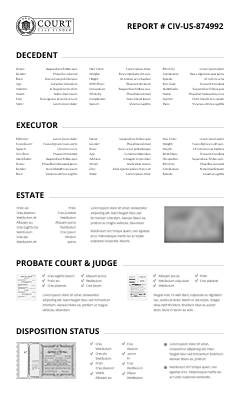
Probate Case Reports
- Decedent Name
- Date of Death
- County
- State
- File Date
- Case Number
All Probate Types
- Case Type
- Judge
- Probate Court
- Estate Type
- Estate Value
- Executor Name
All Case Details
- Executor Address
- Interested Parties / Heirs
- Will Filed
- Disposition Status
- Disposition Date
Providing Instant Probate Court Case Records
for Over 12 Years

Instantly Search Full Probate Court Case Information Online

View Probate Filing Info Including Executor, Estate, Judge, Status, & More

View & Download Unlimited Comprehensive Probate Court Case Reports
Probate Records vs. Wills vs. Estate Inventories vs. Court Orders *
When a person passes away, their estate is typically administered through a legal process known as probate. This process generates several types of records, each serving a different purpose in managing assets, resolving debts, and carrying out the deceased person's wishes.
Probate records, wills, estate inventories, and court orders are crucial documents in the process of administering an estate after someone passes away. Each of these records plays a distinct role in the estate administration process.
-
Probate Records: Probate records are the official case files generated when a court oversees the distribution of a deceased person's estate. These records may include the probate petition, the will, letters testamentary, creditors' claims, and the final distribution of assets. Probate records provide the complete picture of the estate's handling from the beginning to the end.
-
Wills: A will is a legal document created by an individual to outline their wishes for the distribution of their estate after death. It may also name an executor and appoint guardians for minor children. On its own, a will is not a public record; it becomes one when submitted to the probate court as part of the probate process.
-
Estate Inventories: An estate inventory is a document filed during probate that lists the deceased person's assets and liabilities. This inventory may include real estate, bank accounts, vehicles, and other personal property. It is usually prepared by the executor or administrator and filed with the court.
-
Court Orders: Court orders are the formal decisions issued by the probate court throughout the probate process. These rulings authorize actions such as appointing an executor, approving asset sales, resolving disputes, or distributing assets to heirs. Court orders are legally binding and ensure the proper administration of the estate.
How Probate Cases Are Generated & Processed
Probate cases follow a formal, court-supervised process that ensures a deceased person's estate is managed correctly and according to state law. While the specific requirements and timelines may differ across jurisdictions, the process follows a straightforward procedure.
-
Opening the Probate Case: A probate case begins when an executor named in a will, or an administrator if no will exists, files a probate petition with the county probate court. This filing identifies the deceased person, establishes the court's authority, and requests legal permission to manage the estate. Once accepted, the court assigns a case number and officially places the estate under judicial oversight.
-
Notice, Inventory, and Administration: After the case is opened, notice is given to the heirs, beneficiaries, and any known creditors. Creditors are typically provided a limited period to submit their claims against the estate. During this stage, the executor or administrator gathers estate assets and files all required inventories or appraisals, specifying property, accounts, and other holdings.
-
Court Reviews and Orders: Probate courts may hold hearings to confirm the will, resolve disputes, or review financial accountings. A judge then issues orders appointing fiduciaries, approving transactions, and authorizing distribution.
-
Final Distribution and Case Closure: The process ends when the court approves final distributions to heirs or beneficiaries and formally closes the estate. At this point, the executor or administrator is released from their responsibility, and the court preserves the entire probate record.
What Kind of Data is Available in Probate Records?
Probate records contain information about the court process for administering a deceased person's estate. These records provide insight into the decedent's assets, liabilities, and heirs and are vital for legal, financial, and genealogical purposes. However, not all information contained in probate records is accessible to the public. Access typically depends on state laws and whether portions of the case are sealed.
Probate Record Content Overview
Record Element |
Included Detail |
Public Access |
Notes |
|---|---|---|---|
Decedent Information |
Name, date of death, residence |
Yes |
Core identifiers |
Executor/Administrator |
Name and appointment |
Yes |
Court-authorized fiduciary |
Heirs & Beneficiaries |
Names or relationships |
Often |
May be limited in some states, such as California, New York, and Florida |
Estate Inventory |
Asset listings and values |
Varies |
Values may be redacted |
Creditor Claims |
Debts filed against the estate |
Often |
Status may be summarized |
Court Orders |
Authorizations and rulings |
Yes |
Legally binding |
Guardianship Entries |
Minor/incapacitated persons |
Limited |
Frequently restricted |
How to Access Probate Records
Access to probate records depends on the court that handled the estate, the age of the case, and the type of documentation being requested. Most probate records are accessible at the county level; however, the method of requesting the document varies by jurisdiction.
Online Probate Records Lookup Options
Many county and state courts provide online probate search tools that allow users to locate probate cases by the decedent's name, case number, or year of filing. These portals usually display case summaries, filing dates, party names, and current status, helping users confirm whether probate was opened and where it was handled.
Offline Access
When complete probate files, certified copies, or older cases are required, accessing probate records offline may be the best bet. The clerk of the probate or surrogate court in the county where the estate was administered is the official records custodian. Requests may be made in person, by mail, or through formal request forms, depending on the court rules.
Identification, Fees, and Processing Times
When requesting probate records, courts typically require valid identification, especially for certified copies, to verify the request's legitimacy. In some cases, proof of legal interest, such as being an heir, beneficiary, or attorney, may be required for certain filings.
The fee for obtaining certified copies of probate records varies significantly across states and even within counties within a state. For example:
-
In California, online searches are generally free, but certified copies of documents can cost around $25 to $30, with additional charges for copies and search requests.
-
In New York, there is a $10 fee for a probate search request, and certified copies cost about $5 per document.
-
Similarly, in Texas, certified copies can cost between $5 and $10 per page, depending on the county.
Processing times also vary widely. While online searches typically provide immediate results, requests for certified copies and older probate files often require additional time. In California, certified probate records are usually processed within 5 to 10 business days, though archived records can take 2 to 3 weeks.
In New York, probate record requests typically take 7 to 14 business days, with surrogate courts noting longer timelines, sometimes 3-4 weeks, for historical cases. Texas counties usually process certified probate documents within 3-7 business days.
How Long Does It Take to Find Probate Records
The time required to locate probate records depends on the age of the case, where it was filed, and how the court stores its files.
Instant Online vs. Manual Retrieval
Recent probate cases may appear instantly through online court portals, allowing users to confirm filings within a few minutes. Older cases, however, may not be digitized and require manual retrieval from courthouse archives. In such situations, locating records may take several days, especially if staff must retrieve physical files or the document is stored in off-site facilities.
Why Probate Searches Return Partial Results
Probate searches sometimes show limited information because not all documents are publicly indexed online. Many systems display only basic case details, such as the estate name, case number, and filing date, leaving detailed findings, including asset inventories or accounting, available only through formal requests.
What Slows Probate Searches Down
Searches take longer when:
-
The filing year or county is unknown.
-
The decedent has a common name.
-
The case spans multiple proceedings.
Why Use CourtCaseFinder for Probate Records
Locating probate records can be complicated, especially when estates involve multiple counties or when records are spread across different court systems. CourtCaseFinder simplifies this process by providing a centralized platform that improves efficiency, accuracy, and accessibility. Generally, CourtCaseFinder offers users the following:
-
Centralized Estate and Probate Record Searches: Probate cases are filed at the county level, so a decedent with assets or residence in multiple jurisdictions may have records scattered across several courts. CourtCaseFinder supports multi-county and cross-state searches, enabling users to quickly identify relevant probate cases on a single platform, thereby reducing the risk of missing important records.
-
Avoiding Multiple Court Portals: Many courts maintain separate online portals with unique rules and interfaces, making navigation time-consuming and confusing. CourtCaseFinder provides a single, standardized search experience, eliminating the need to manage multiple local systems while delivering consistent results.
-
Time Savings for Professionals: Attorneys, title companies, and real estate professionals benefit from faster access to probate records, reducing administrative tasks and speeding up estate research, due diligence, and title verification.
-
Verifying Records Before Official Requests: Before requesting certified copies or formal clerk-assisted documents, users can confirm the existence of a probate case and identify the correct jurisdiction. CourtCaseFinder helps prevent unnecessary fees, delays, and repeated inquiries, making follow-up actions faster and more efficient.
Frequently Asked Questions about Finding Probate Records
How do I find probate records if I don't know the county where the estate was filed?
If you are unsure of the county, you can search statewide court portals or use multi-county search tools to help identify the correct jurisdiction.
Can probate records be accessed if there was no will?
Yes, probate records are still available even if there was no will. When someone dies intestate (without a will), the court steps in to oversee the distribution in accordance with state law.
Are probate records available for small estates or summary administrations?
Yes, probate records for small estates or summary administrations are available in many jurisdictions. However, these records may be limited, typically containing only basic details about the estate and its distribution.
Do probate records include copies of death certificates?
Probate records typically do not include copies of death certificates. However, if you require one to start probate proceedings, you may request the certificate from the vital records office separately.
Can probate records be accessed for living persons under guardianship or conservatorship?
Yes, guardianship and conservatorship cases are usually handled within the probate court system, but access to these records may be restricted to protect the privacy of the individuals involved.
How long after death does a probate record become publicly searchable?
Probate records are usually searchable as soon as the probate case is filed in court. The timelines vary across jurisdictions, depending on when the executor begins the process and the court's procedures.
Are probate records removed or sealed after an estate is closed?
In most cases, probate records remain accessible even after an estate is closed. However, certain sensitive parts of the case, such as personal information, may be sealed or redacted to protect privacy.
Can I access probate records from another state without visiting the court in person?
Yes, many probate courts are available online, and you can access them from anywhere in the U.S. by using online search portals or third-party aggregation services. Some counties or states may require in-person or mail requests.
Do probate records show disputes or litigation between heirs?
Yes, probate records may include documentation of disputes or litigation, such as motions, objections, and court orders addressing conflicts among heirs or beneficiaries.
Can probate records be corrected if there is an error in the case file?
If there is an error in a probate record, it may be corrected by filing a court motion or by filing amended documents with the court for approval.
Can probate records be used for real estate and title searches?
Yes. Probate records are commonly used to confirm who has legal authority to transfer property, identify heirs, and resolve title issues after a death.
What types of probate cases generate probate records?
Probate records arise from estates with a will (testate), without a will (intestate), ancillary probate for out-of-state property, and both supervised and unsupervised estate administrations.
How long does probate take, and when do records become available?
Probate can last several months to over a year, depending on the estate's complexity and any disputes, but it usually becomes publicly searchable shortly after the case is filed.
When is probate required, and when can it be avoided?
Probate is generally required when assets are solely owned by the deceased. Probate can be avoided through trusts, joint ownership, beneficiary designations, or small-estate procedures, depending on state law.
How do I obtain certified probate documents?
Certified copies of probate records are typically requested from the probate court clerk handling the case. Access usually requires a written request, identification, and a certification fee.