Instant Bankruptcy Filings Lookup
Debtor, Trustee, Creditors, Filing Date, Case Status, & More
- This Search is Secure and Confidential
- Last updated on October 27, 2026
Bankruptcy Case Reports
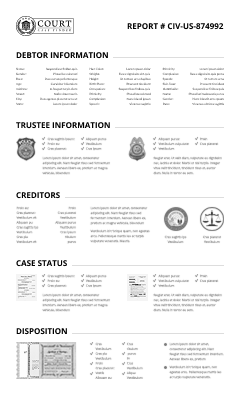
- Debtor Name
- Debtor Address
- Bankruptcy Case Number
- Bankruptcy Chapter
- Filing Date
All Bankruptcy Types
- Court Name
- Federal District
- County
- State
- Case Status
All Bankruptcy Details
- Discharge Date
- Trustee Name
- Trustee Address
- Creditor Names
- Meeting of Creditors Date
Providing Instant Bankruptcy Records
for Over 12 Years

Instantly Search Full Bankruptcy Court Case Information Online

View Bankruptcy Filing Info Including Debtor, Trustee, Creditors & More

View & Download Unlimited Comprehensive Bankruptcy Court Case Reports
Bankruptcy Filings vs. Civil Judgments vs. Liens vs. Credit Reports *
If a business or an individual is undergoing a financial crisis, various legal and reporting documents are created. Bankruptcy filings, civil judgments, liens, and credit reports. Knowing the difference between a bankruptcy filing, a civil judgment, a lien, and a credit report will enable you to perform an accurate search and understand the results.
Bankruptcy filings are filed in the federal court under the U.S. Bankruptcy Code for individuals seeking relief from their debt or reorganization. Only bankruptcy courts in the U.S. deal with these matters. They can grant discharge of debts, put in place repayment plans, or liquidate assets. When a person applies for bankruptcy, the federal courts create a file that includes a petition, schedules, lists of creditors, and discharge orders.
A judgment rendered by a civil court ordering the losing party to pay an amount of money or to comply with other orders of the court is a civil judgment. Most lawsuits regarding unpaid debts, breach of contract, damage, and similar claims result in judgment. An unpaid civil judgment might make the debtor want to declare bankruptcy in many cases.
Liens are legal claims against property to ensure the payment of a particular debt. A lien may result from civil judgments, taxes, or contracts, such as mortgages. Bankruptcy proceedings can affect liens on your property by restructuring, avoiding, or discharging them. What happens depends on the lien type and the chapter you file under.
Credit reports are summaries compiled by credit bureaus, not the courts. Such events may indicate bankruptcy, a judgment, or a lien being placed on it. Although credit reports have access to court data, they are not the same as court records. They're regulated by federal consumer laws.
Types of Bankruptcy Filings
Bankruptcy filings are made under the federal bankruptcy code. It groups bankruptcies into chapters based on the debtor's condition and the aim of the bankruptcy filing. Every chapter provides a distinct set of rules that allow for the provision of debt relief or reorganization.
Chapter 7 Bankruptcy
A Chapter 7 bankruptcy is called a liquidation bankruptcy. Under this procedure, qualified individuals or organizations can dispose of certain unsecured debts after a trustee examines the case and sells any non-exempt assets. After this, the proceeds from the sale are used to pay creditors. A large number of consumer Chapter 7 cases do not involve much asset liquidation due to statutory exemptions, and a qualifying debtor may receive a discharge within a number of months.
Chapter 11 Bankruptcy
Chapter 11 bankruptcy is generally used for the reorganization designed for businesses in debt. Nevertheless, consumers with huge debts can also file for bankruptcy under this chapter. This allows the debtor to continue operations while debts are restructured under a court-approved organization plan. Cases under Chapter 11 are generally involved with more complex issues and typically involve negotiations with multiple classes of creditors.
Chapter 13 Bankruptcy
A Chapter 13 bankruptcy filing enables individuals to repay debts over a period of three to five years. Debtors seek to repay a portion or all of their debts through a repayment plan that does not involve liquidation. The remaining eligible debts may be discharged once the repayment plan is completed.
Other Chapters (Brief Overview)
-
Chapter 12 (family farmers/fishers): Chapter 12 was made for family farmers and family fishers with a regular income and custom repayment plans.
-
Chapter 9 (municipalities): Chapter 9 permits cities or municipal entities to reorganize their debts while still providing essential government services.
How Bankruptcy Cases Are Generated & Processed
From the moment you file a bankruptcy case all the way up to when your case is closed, each step creates court records and activates protections for all parties.
-
Filing the Bankruptcy Petition: A bankruptcy case starts with the filing of a petition with the U.S. Bankruptcy Court. Usually, debtors file voluntarily because they want relief from their debts. In rare situations, creditors may choose to file an involuntary petition if the debtor meets certain criteria.
The petition must contain a complete financial disclosure, with details about your assets, debts, income, expenses, names of the creditors, and prior financial activity. This information is submitted under penalty of perjury, meaning it is truthful and complete.
-
Automatic Stay: Once you file for bankruptcy, an automatic stay goes into effect. It is a strong federal protection that temporarily stops almost all collection efforts. As a rule, lawsuits, wage garnishments, foreclosure actions, repossession, and collection calls must stop.
The automatic stay continues during the bankruptcy case unless a creditor makes a request to the court to lift it and the judge agrees.
-
Trustee Appointment and Creditors Meeting: After the filing, a bankruptcy trustee is appointed by the court. The trustee's job is to assess the debtor's documentation, check that the information is correct, and manage any property that needs to be paid to the creditors.
The debtor is also required to attend a Section 341 meeting of creditors. The debtor responds under oath to inquiries concerning their financial situation through this meeting.
-
Court Proceedings and Objections: Creditors or other parties may file motions or objections throughout the case. One example of an objection is a creditor arguing that a debt should not be discharged in a bankruptcy case. Alternatively, a creditor might argue that a debtor did not provide accurate information.
Some disputes escalate into contentious litigation. This becomes an independent lawsuit within a bankruptcy case, requiring additional filings, hearings, and judicial rulings.
-
Discharge or Dismissal: There are primarily two ways through which a bankruptcy case ends: discharge or dismissal.
-
Discharge: When a court grants a discharge, some qualifying debts may be legally eliminated. As a result, you will no longer have to pay those debts, and creditors generally will not be allowed to try to collect them anymore.
There are several common types of debt that can be discharged in bankruptcy. These often include credit card debt, personal loans, and medical bills, depending on the type of bankruptcy and situation. After the discharge order is issued, the debtor gets a clean financial slate because those debts are permanently removed.
However, not every debt can be discharged. Certain obligations generally do not get eliminated through bankruptcy. Generally, the debtor must continue paying certain obligations, including taxes, student loans, and child support.
-
Dismisal: A dismissal means the bankruptcy case is closed without granting debt relief. In such circumstances, the court halts the bankruptcy proceedings and terminates the case's protections.
A case may be dismissed for several reasons. For example, the debtor might fail to file required documents, miss court deadlines, or not follow court orders. Sometimes a debtor may voluntarily request dismissal, or the court may dismiss the case if it determines that the filing does not meet legal requirements.
Oftentimes, debts aren't always wiped out when a case is dismissed. Creditors may begin calling you, filing lawsuits, or garnishing wages once again. In effect, the debtor is returned to the position he was in before he filed for bankruptcy, although the bankruptcy filing may still appear on the credit report.
-
The final ruling is entered in the federal court docket and made part of the public bankruptcy record.
What Kind of Data Is Available in Bankruptcy Records
Bankruptcy records are the official documents generated by a federal court. They contain detailed information regarding a debtor's case. Bankruptcy requires a full disclosure of all relevant assets, debts, income, obligations, and more.
Although bankruptcy records are public records, not all information is open to the public. Certain personal identifiers must be redacted due to federal privacy laws. Bankruptcy records contain a variety of data types, which can be categorized as follows:
Data Category |
Typically Included |
Publicly Accessible |
Notes |
|---|---|---|---|
Debtor Identifiers |
Name, partial SSN, city/state |
Yes (limited) |
Full SSN is redacted |
Case Information |
Case number, filing date, district, chapter type |
Yes |
Core docket data |
Financial Disclosures |
Assets, liabilities, income, creditor list |
Yes (with limits) |
Sensitive data redacted |
Case Status |
Active, discharged, dismissed, converted |
Yes |
Updated as the case progresses |
Court Orders |
Discharge orders, confirmations, rulings |
Yes |
May require access fees |
Restricted Data |
Full SSN, bank account numbers |
No |
Protected under federal rules |
How to Access Bankruptcy Filings
Bankruptcy cases are handled solely in federal court; therefore, the process for accessing them differs from state court filings.
Online Bankruptcy Lookup Options
Public Access to Court Electronic Records (PACER) lets you access bankruptcy filings online. This system allows access to all cases from U.S.bankruptcy courts. To search bankruptcy records, you can use the name of the debtor, case number, and judicial district. Typically, the record search presents the docket entries, field documents, the status of a case, and court orders.
If you don't know where the bankruptcy was filed, you can search the federal districts through PACER. The platform allows you to search multiple federal district courts at the same time.
Offline Access Options
If you cannot find the records online, or you would like certified copies, contact the Clerk of the U.S. Bankruptcy Court for the district in which the case was filed. The court clerk's office usually has the official court document on file, which you can request a copy of.
Older bankruptcy records, particularly those not found on PACER, can usually be found at the district court archives where the case was adjudicated.
Identification, Fees, and Processing Times
Accessing federal bankruptcy records usually involves fees. Online systems charge per page for viewing and downloading documents. Certified copies requested through the clerk's office require additional certification fees. In addition, in-person requests typically require you to present valid government-issued identification to retrieve certified copies.
-
Online access fee via PACER is about $0.10 per page viewed or downloaded. The maximum fee per document is $3.00 (about 30 pages). If your total PACER charges are $30 or less per quarter, the fees are waived for that period.
-
It costs $0.10 per page to print bankruptcy documents at the public terminals at the District of Columbia Bankruptcy Court. Certified copies cost $11.00 plus $0.50 per page. There is also a $31.00 search fee. Requests are typically processed the same day, especially if the record is currently in custody.
-
For bankruptcy records from the Eastern and Northern Districts of Texas, certified documents cost around $12.00 plus $0.50 per page. Copies printed at the courthouse cost about $0.10 per page. There is a $34.00 per name/case search fee. Requests are usually processed in a few business days after payment, though archived retrievals can take longer.
-
In the Southern District of California, San Diego, certified copies (in person) cost about $11.00 + $0.50 per page, while mail-certified copies cost $31.00 search fee per item plus $11.00 certification and $0.50 per page. Processing times vary, but the courts typically respond within business days once the fees are received.
How Far Back Do Bankruptcy Records Go?
The rules for keeping bankruptcy records are set by the federal court system. In many cases, bankruptcy files are kept for a very long time. How you access them, however, depends mostly on when the case was filed and whether it has been converted into a digital record.
In general, most bankruptcy petitions, especially those that resulted in a discharge, are permanently preserved in the national court record. Older case files may not always be available at the local courthouse, but that does not mean that they get destroyed. Typically, these files are sent to a federal archive.
Due to this system, it is still possible to find an old bankruptcy case filed away in the archives. However, the process of getting it back might involve more procedures.
In the late '90s and early 2000s, bankruptcy courts began using electronic case management systems. Accordingly, you can find most cases filed after that time using the federal online court systems, PACER.
Cases filed before electronic filing may not show completely online. Federal record centers generally retain such prior files. Generally, the way to obtain them is to contact the clerk of the bankruptcy court where the case was originally filed and formally request that the case be archived.
How Long Does It Take to Find Bankruptcy Records
How quickly you can find a bankruptcy record will really depend on a few factors, including when the case was filed, how you're searching for it, and how much identifying information you have. Most bankruptcy records can be found easily because they are federal court system cases. Despite that, finding older or more complex files may take longer.
Instant Online Results vs. Clerk Requests
If the bankruptcy was filed in the last few years, you can generally find it the same day using PACER. Usually, when you search by name or case number, you get the docket's information in a matter of minutes.
If the case is older or a certified copy of a document, such as a discharge order, is needed, it can take longer to get the documents. In these cases, it may be necessary to call the clerk of the bankruptcy court. Requests for archived files or certified documents can take a couple of business days to be completed. This timing usually depends on the court's workload and whether the file is stored off-site.
Why Bankruptcy Searches Return Partial Results
Sometimes a search may not yield results as you'd expect. Usually, this is due to privacy protections. According to federal rules, certain personal information, such as complete Social Security numbers and financial account numbers, must be redacted.
In other cases, the record may appear incomplete because the bankruptcy was converted from one chapter to another or transferred to a different district. When this happens, the case actions may be distributed throughout several docket entries.
What Slows Bankruptcy Searches Down
A common name would produce many results, especially without a middle initial or filing district to narrow down the search. Extra verification may be required for cases filed under business names, partnerships, or trade names.
In more complex scenarios, bankruptcy filings may be in more than one federal district. These multi-district cases can take extra time to put together, especially if you are trying to review the full history of the matter.
Public vs. Sealed Bankruptcy Records
Federal courts preside over all bankruptcy cases, and their records are mostly public. However, public access doesn't always translate to unrestricted access. The information you can see and how you see it is limited by federal privacy laws and court rules.
Are Bankruptcy Filings Public?
In most cases, bankruptcy filings are public record. This means members of the public can review and request copies of case dockets, petitions, financial schedules, and discharge orders through the federal courts. Unless a judge seals the records, the basic facts of bankruptcy cases are public.
Bankruptcy records are searchable nationwide because bankruptcy is a federal issue and is not subject to state courts. This centralization ensures that filings can easily be located even if parties or businesses relocate to another state.
Exceptions and Redactions
Federal law requires the restriction of personal identifying information. Therefore, social security numbers, bank account numbers, and other such identifiers must be redacted.
Under certain circumstances, the court may seal a document or limit access to certain information. Restricting access to private information is usually aimed at preserving one's privacy, security, or an individual's identity.
Impact on Credit and Criminal History Checks
Bankruptcy filing is likely to reflect on your credit report. Under federal consumer protection laws, bankruptcies may appear on a credit report for several years. Chapter 7 cases typically last longer than Chapter 13 cases.
It's essential to know that the laws governing credit reporting and access to the courts differ. Even if a bankruptcy no longer appears on your credit report, the court record will most likely remain within the federal system.
Why Use CourtCaseFinder for Bankruptcy Lookup
Bankruptcy cases are filed in federal court, so records are kept in different judicial districts. Each district has its own processes and databases for obtaining bankruptcy records. CourtCaseFinder simplifies the process of looking up bankruptcy case information, saving you from the trouble of visiting different court websites to gather the information you need.
-
Centralized Federal Bankruptcy Search: Bankruptcy cases are filed in U.S. Bankruptcy Courts, which are located throughout the United States. This can make record searches complicated if you are not aware of the actual court. CourtCaseFinder provides a centralized federal bankruptcy search tool to help you find possible filings without having to choose a district first.
-
Avoiding Multiple Federal Court Portals: Though all federal courts operate under the same rules, each district manages its own system, making searching across multiple states tedious. CourtCaseFinder simplifies the process so you don't have to go searching individual federal court websites at the outset.
-
Faster Financial Due Diligence: Lenders, attorneys, investors, and compliance professionals often need to verify bankruptcy status quickly to evaluate risk or review applications. CourtCaseFinder helps users conduct early-stage due diligence to discover if a filing is available before spending any more time obtaining complete court filings.
-
Confirming Bankruptcy Before Official Requests: Since certified court copies and extensive federal searches can be costly, it generally makes sense to first verify that a bankruptcy case exists and identify the appropriate district. Using CourtCaseFinder, you can verify basic details upfront and avoid unnecessary expenses.
Frequently Asked Questions About Bankruptcy Filings
How can I search for federal bankruptcy filings by name or case number?
You can search bankruptcy cases through the federal court's online record system using the person's legal name, case number, and the district where the case was filed.
What information is included in a bankruptcy case report?
A bankruptcy filing will show the debtor's name, case number, chapter type, date of filing, court district, trustee, and the case's current status.
Can I see whether the bankruptcy was discharged, dismissed, or still active?
Yes. The case docket would reflect whether the case is pending discharge, has been dismissed, or has been converted.
How do I verify if someone has filed for bankruptcy recently?
Search the database of the federal bankruptcy court using the actual legal name of the person, and take notice of the filing date indicated in the results.
What court handles bankruptcy cases, and where are they filed?
Bankruptcy cases are heard by U.S. bankruptcy courts only. They are usually filed in the federal district where the person lives or does business.
Can bankruptcy records be sealed or removed?
Most of the bankruptcy records are public by default and rarely sealed. However, other personal documents may be restricted or redacted.
Do bankruptcies appear in state court searches?
Bankruptcy is not handled by state courts, which means you won't find them in any state court searches.
Can I access creditor lists, assets, liabilities, or trustee information?
Yes. Many bankruptcy filings come with schedules containing creditors, assets, and liabilities, and the appointed trustee, though sensitive information is redacted.
What does "automatic stay" or "discharge" mean in a case summary?
An automatic stay is a court order that prevents most debt collection activities from continuing when a bankruptcy case is filed. A discharge relieves the debtor of the responsibility to pay certain debts.
Can I download official bankruptcy case documents?
You can typically download official case documents from federal court record systems, though access may require copying fees.
Does filing for bankruptcy stop lawsuits immediately?
Yes, the filing will automatically trigger a stay, which usually stops lawsuits and collection actions from continuing, with limited exceptions.
What to do if you can't find a bankruptcy filing?
If you cannot find a filing, make sure you have the correct federal district and that you are looking for variations in name or business entities. Also, consider possible delays in filings or archived records.
What happens if someone files for bankruptcy more than once?
In certain cases, multiple filings are permitted, but the eligibility for discharge and waiting period will depend on the outcome and timing of the earlier case.
Are joint bankruptcy filings searchable under both spouses' names?
Yes. In federal bankruptcy searches, joint cases commonly display both spouses' legal names.