Instant Property Court Case Lookup
Ownership Disputes, Land Use, Foreclosures, Easements, Evictions, & More
- This Search is Secure and Confidential
- Last updated on October 23, 2026

All Housing Court Records
- Evictions
- Nonpayment of Rent
- Lease Violations
- Habitability Claims
- Security Deposit Disputes
All Property Court Cases
- Title Disputes
- Quiet Title Actions
- Ownership Disputes
- Deed Disputes
- Adverse Possession Claims
All Property Case Types
- Boundary Line Disputes
- Easement Disputes
- Encroachment Claims
- Land Use Disputes
- Property Damage Claims
Providing Instant Property Court Case Records
for Over 12 Years

Instantly Search Full Property Court Case Information Online

View Property Court Info Including Owner, Leases, Case Status & More

View & Download Unlimited Comprehensive Property Court Case Reports
Property Court/Housing Court Records *
Property and housing court records are public legal documents generated when landlords, tenants, or lenders file cases regarding residential property, most commonly evictions (summary process), non-payment of rent, or safety/building code violations.
These records indicate if a person has been sued in housing court, providing details on the case type, judgment, and tenant history. These records are used in tenant screening, eviction filings, housing disputes, and code enforcement.
Landlords use these records to screen potential tenants for previous evictions, damages, or unpaid rent judgments. These include cases where landlords seek to regain possession of a property, including "non-payment" and "holdover" cases. Land court records cover cases regarding breaches of lease, personal injury on premises, and landlord harassment. These records may include documents relating to repairs, building code violations, and administrative appeals.
How Are Property/Housing Court Records Generated and Processed?
Property and housing court records, most often evictions, foreclosures, and landlord-tenant disputes, are generated when a property owner, agent, or attorney files a lawsuit to regain possession of a property. These records are generated through legal forms submitted to the court, processed through case management systems, and often collected by third-party services for tenant screening and other purposes.
An example would be a landlord or bank that files a complaint (such as a Summary Process or eviction lawsuit) to start the legal process. Some of the documents filed are the complaint, summons, tenant answers, and official court orders or judgments.
Some housing court cases are resolved through mediation. When the parties reach an agreement, it is often recorded and becomes part of the official record, even if a judge does not issue a formal ruling.
Property court records information is entered into court systems by clerks, including case numbers, filing dates, and the final judgment, which is often an abstract of the possession ruling. Many courts have shifted to digital systems (such as Tyler Technologies or individual state portals), where documents are scanned and submitted online.
Courts transfer the submitted forms into case management systems that store case details, sometimes electronically, sometimes on paper. If a hearing occurs, judges, staff, and clerks update the case status and document whether the landlord or the tenant won. Records are typically kept at the local courthouse for a set period (e.g., 1-2 years) before being transferred to national archives or electronic public-access databases.
Unless sealed by a court order, most housing court records are public records available through in-person requests, online court portals, or third-party databases. Commercial companies update their databases with these records daily to provide tenant screening reports to landlords. Eviction records can remain in public databases for up to seven years.
What Kind of Data is Available in Property/Housing Court Records?
Property and housing court records contain detailed information on disputes between landlords and tenants, with a heavy focus on evictions, rent possession, and lease violations. Some of the data points include tenant names, addresses, eviction lawsuit filings, judgments, monetary damages (back rent), and judge rulings. These public records are often used in tenant screening reports. Some details of the data included are as follows:
Court Records
-
Case Information: Case numbers, court type (e.g., municipal, superior), and filing dates.
-
Parties Involved: Names of landlords, property management companies, tenants, and their legal counsel.
-
Case Type and Status: Eviction suits (unlawful detainer), breach of lease, failure to pay rent, and whether the case is open, closed, or a default judgment.
-
Judgments and Outcomes: Specific decisions (e.g., possession granted to landlord), money judgments owed to the plaintiff, and case dismissals.
-
Property Details: Address of the property involved, which may be collected in local, state, or national court databases.
Property Records
-
Property Ownership Details: Current owner name, mailing address, and title details.
-
Property Characteristics: Address, parcel ID (lot number), square footage, building area, year built, number of stories, and zoning.
-
Land Use: Tax assessment data, prior sales, and improvements like pools or garages.
Although most are publicly available, not all records are fully digitized and may require manual searches. Keep in mind that address data might not be validated, and sealed or dismissed cases may not appear in background checks. Additionally, records may be limited to a specific time, such as the last 36 months.
How to Access Property/Housing Court Records
Accessing property/housing court records depends on the type of filing and the state where the case was recorded. You can generally find records through the local county court website, specialized state judicial portals, or by visiting the courthouse in person (specifically, the clerk court of land records). Housing laws are highly localized, and there is no single government database to search, but you can use services like CourtCaseFinder to locate the records you need. The different search methods are detailed below.
Online Search (State and County Portals)
Most states now offer online case systems (often called portals or docket searches) where you can enter information and find case files. Use search terms like "[State] court case records", "[County] clerk of court civil cases", or "clerk of courts property records".
You generally need the tenant/landlord name or the case number assigned to the file. You may also need to know the specific eviction type (often called "Forcible Entry and Detainer" or "Summary Process").
Some state examples:
-
New Hampshire: Uses a Case Access Portal for e-filing of civil and small claims cases.
-
Massachusetts: Offers a Case Access Portal specifically for the Housing Court department.
-
Rhode Island: Uses a public portal for electronic access to case information.
In-Person Search at the County Courthouse
If records are not available online, you can find them at the courthouse by visiting the Clerk of Court, Superior Court, or local District Court (or other court that houses land court records) where the property is located.
You can also visit county recording offices (e.g., Register of Deeds) to find recorded Lis Pendens, which indicate that a bank has initiated foreclosure on a property.
Third-Party Tenant Screening Services
Landlords or property managers who check eviction histories frequently may use a specialized third-party database or service to run regular searches. Companies like CourtCaseFinder aggregate housing court records from dozens of locations across the U.S. and update them daily.
Federal Court Records (PACER)
If a housing case was filed in federal court (e.g., a bankruptcy affecting property), you can access records through the PACER (Public Access to Court Electronic Records) system. You will need to register for an account to view documents.
Some states allow tenants to seal eviction records under certain circumstances, meaning they will not appear in public searches. Some searches may be free, but you might have to pay a fee to print or download documents. Juvenile, adoption, and certain high-profile cases may be confidential.
Fees and Processing Timelines
When using the PACER system, you can expect to pay between $0.10 and $3.00 per document with a $30/quarter fee waiver. Depending on the state system you search, you will pay roughly $0.50 to $33+ per document. Electronic records are often available instantly or within 24 hours, while physical records at the state level can take days and often involve search fees. Commercial systems can sometimes offer a faster, more efficient approach to searching.
Types of Cases & How to Search
Typical property/housing court cases include evictions, landlord-tenant disputes, and foreclosures. You can generally search using the owner's or tenant's name, the address of the property, or the case number.
Property and housing court records document most often disputes between landlords, tenants, and property owners. Common case types include eviction proceedings (possession of property), landlord-tenant disputes (rent non-payment, damages), code enforcement actions, breach of contract, property damage claims, and zoning board appeals.
Common Case Types in Housing/Property Court Records
-
Evictions (Summary Process): Cases where a property owner, bank, or landlord files to regain possession of a property.
-
Landlord-Tenant Disputes: Disputes over rent, damages, and lease breaches.
-
Code Enforcement Actions: Violations of building codes, health codes, or safety regulations.
-
Small Claims/Housing Civil Cases: Disputes involving property damage or financial claims related to renting.
-
Zoning and Title Disputes: Appeals from local zoning boards and disputes over real estate title ownership, typically heard in superior courts.
-
Replevin Actions: Legal action to recover personal property.
-
Injunctive Relief: Petitions to stop actions, such as proposed construction or illegal evictions.
Property/housing court records become public when a court filing or judgment is entered. These records, often summarized as judgments for possession, are frequently used in tenant screening reports to show if a tenant has been previously sued. Records often include the amount of rent owed, the reason for the filing, and the final judgment.
These cases are typically handled in specialized housing courts, district divisions, or probate courts, depending on the jurisdiction.
Why Use CourtCaseFinder for Property/Housing Court Records Lookup
Searching court records manually can be time-consuming and frustrating. It can be difficult to locate the correct court or government office where the files are located. Although many are available online, you might need to visit multiple local courthouses or county offices in person to obtain records.
CourtCaseFinder offers a much better solution, putting millions of records at your fingertips instantly. With a single search, you can pull data from multiple sources and aggregate it into a nice, easy-to-read report that contains everything you need. The data comes directly from court offices, local city/county records offices, and other government sources. In most cases, data is updated daily or weekly, depending on the state's reporting schedule and the specific court type, and will match what you can find there.
Searching through court or county online portals may offer a free search option, but you may be limited to the information you can find, and you won't be able to print, download, or order certified copies. Other limitations include restricted access to sensitive case types, incomplete records for older cases, and, in the end, you may still have to visit the courthouse in person for the full documentation.
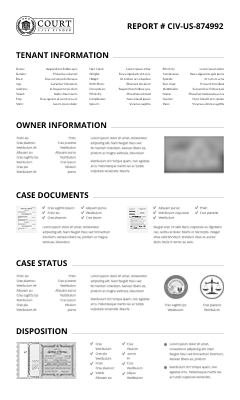
With CourtCaseFinder, you get a full property court records report, including dozens of data points such as:
-
Name and Location
-
Case Number
-
Case Summary
-
Court Records
-
Court Case Details
-
Local, District, Municipal, State, and Appellate Courts
-
Land/Property/Small Claims
-
Federal Court Records
-
Property Liens and Judgments
-
Fines
-
Claims Reports
-
Court Files
-
Trial Processes
-
Clerk's Office Data
-
Appeals
-
Resolutions
-
Property-Related Bankruptcy Files
-
Police Reports
-
Criminal Records
-
And Much More!
Frequently Asked Questions
Can I search eviction records by address?
Although state court search tools vary, you can generally search for eviction records by address. Along with searching through state/county court portals, you can also use specialized third-party services like CourtCaseFinder to find records easily online, or you can visit local courthouses in person.
How long do eviction records stay on file?
Eviction records typically stay on a tenant screening report for seven years. However, the physical court records may exist indefinitely. Many background check companies and credit bureaus stop reporting them after seven years. Monetary judgments for unpaid rent can remain on credit reports for up to 7 years if not satisfied.
Can records be removed or disputed?
Yes, housing court records (evictions) can often be sealed, expunged, or disputed, depending on state laws and the case outcome. Sealing removes records from public view, while expungement destroys them. Tenants can dispute inaccuracies on tenant screening reports and may request that courts seal the records if the case was dismissed, settled, or occurred years ago. In some cases, a landlord may agree to vacate a judgment or cooperate in sealing the record if the debt is settled.
Do dismissed or sealed housing cases appear in records?
Tenant-landlord laws and record sealing procedures vary widely by state and local jurisdictions. However, dismissed housing cases (evictions) often remain in public court records and may appear on tenant screening reports, even if they didn't lead to a judgment. Conversely, sealed or expunged records are hidden from public view and background checks, preventing them from appearing on screenings, although some errors may cause them to appear briefly. Third-party background screening companies may still have records of a dismissed case in their databases.
Are housing court records the same as property ownership records?
No, housing court records and property ownership records are not the same. Property ownership records (deeds/tax records) identify who owns a property. Housing court records are legal documents detailing disputes, such as evictions or code violations, which will show legal actions against a landlord or tenant rather than ownership itself.
Will I see ongoing or active cases in the results?
Yes, you will generally see ongoing or active property and housing court cases in the results when searching public records, including evictions (unlawful detainers), landlord-tenant disputes, and property ownership lawsuits. Online court portals often allow you to check the status of pending cases, upcoming hearing dates, and recent filings, such as in the Connecticut Judicial Branch housing session or New York's WebHousing systems.
Can I search for housing court records across multiple states at once?
Yes, you can search for housing court records across multiple states at once, although most state-level housing cases are handled at the local county level. The most efficient ways to search multiple jurisdictions simultaneously are through specialized, paid tenant screening services and national research platforms like CourtCaseFinder, which aggregates data from multiple sources across all U.S. states.
What's the difference between housing court and civil court records?
Housing court records focus specifically on property disputes (evictions, habitability, and rent issues) and are often used in tenant screening to show possession judgments. Civil court records are broader, covering monetary disputes (such as medical debt and breach of contract), general lawsuits, and restraining orders. Housing courts are specialized, while civil courts handle a wide range of legal claims.
Do property court records include notices like "Notice to Quit" or filings before eviction?
Yes, property court records often include documents filed before an eviction, such as a "Notice to Quit" or "Notice to Vacate", provided they are submitted as part of the official lawsuit filing. Note: A Notice to Quit or "pay or quit" notice is usually a private letter from the landlord to the tenant. It is not a public record at the moment it is served. If the tenant does not comply, the landlord files an eviction lawsuit (Summary Process or Forcible Entry and Detainer). The landlord is often required to attach a copy of the original "Notice to Quit" and the certificate of service to this initial court filing, making it part of the public record. If the tenant pays the rent or fixes the lease violation before the landlord files the lawsuit, the case is never filed, and the notice does not become part of the public court record.
How do I check if a property has legal issues?
To check if a property has legal issues, conduct a thorough title search through the local county Registry of Deeds, examine court records, and verify tax/utility records. Look for liens, easements, boundary disputes, landlord-tenant problems, or chain-of-title issues.
How do I research a landlord or tenant before renting?
To research a landlord or tenant, you will want to verify their financial stability, rental history, and legal background. Landlords should use rental applications to check credit/background reports, verify income (3x rent), and call previous landlords. Tenants should check county property records to confirm ownership, look up court records for lawsuits, and interview current tenants.
Is it legal to search for eviction or housing history?
Yes, it is legal for landlords to check eviction and housing history during the tenant screening process. Eviction records are generally public court records, which anyone can check directly through court databases, professional screening services, or by contacting previous landlords. These records are available/searchable for up to seven years.
Can I see case outcomes, judgments, and eviction filings?
Yes, you can generally view housing court records, including eviction filings, case outcomes, and judgments, as they are all considered public records. You can access these documents through online state court portals, in person at county courthouses, or through screening services. However, records can be sealed or expunged upon a court's authorization, so you may not be able to find everything you want.
How can I find eviction history for a property or tenant?
Searching county civil or housing court records, online or in person, using the tenant's name or property address, you can find the eviction history for a property or tenant. Most records are public, accessible via local court databases or by visiting the court clerk's office. Use common search terms such as "unlawful detainer", "eviction", or "forcible entry". Evictions are local, so you must search the specific county where the tenancy took place.