Instant Marriage Records Lookup
Party Names, Application, License, Certificate, Status, & More
- This Search is Secure and Confidential
- Last updated on October 23, 2026
Marriage Records
- Spouse 1 Name
- Spouse 2 Name
- Date of Birth(s)
- Age at Marriage
All Marriage Info
- Officiant Name
- Marriage Date
- Marriage County
- Marriage State
All Marriage Details
- License Number
- License Issue Date
- Marriage Certificate
- Marriage Status
Providing Instant Marriage Records
for Over 12 Years

Instantly Search Full Marriage Record Information Online

View Marriage Record Info Including Party Names, Application, License, Status & More

View & Download Unlimited Comprehensive Marriage Reports
Marriage License vs. a Marriage Certificate *
Two types of marriage records exist: a marriage license and a marriage certificate. A marriage license is the legal permission you obtain before your wedding day to legally get married. A marriage certificate is the official document issued after the ceremony that proves you are married. You cannot legally marry without a license, and you cannot get official benefits without a certificate.
Marriage License
A marriage license grants you legal permission from the state/county to get married. Think of it like a learner's permit; it allows you to take the next step but doesn't prove you are married. You obtain your marriage license before the ceremony. Both parties must appear in person at a local clerk's office to provide identification and pay a fee for the license.
A marriage license is time-sensitive. For example, a marriage license might be valid for 90 days. If you don't use it within this window to get married, it expires, and you must start the application process over.
On the wedding day, you hand the license to your officiant. During or immediately after the ceremony, the couple, the officiant, and any required witnesses sign it. Then the license is filed (usually by the officiant) with the county registrar of deeds or recorder's office.
Marriage Certificate
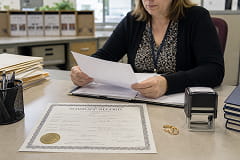
A marriage certificate serves as official, legal proof that your marriage took place. It is your "receipt" and is required to officially change your name, file joint taxes, add a spouse to health insurance, or apply for joint loans. Any time you need to prove that you are married, you must show an official certified copy of your marriage certificate.
You receive the certificate from the local government after the ceremony. Your officiant is legally responsible for mailing or returning the signed license to the government office that issued it.
Once the government records the signed license, they update their vital records to reflect your marriage and generate the certificate. You must request and purchase a certified copy from the state or town vital records office to use for official legal purposes. Certified copies usually cost between $10 and $15, depending on the town/county. If you order multiple copies at one time, you get a discounted rate.
Sometimes, couples receive a decorative, non-official certificate during their ceremony for photo opportunities or framing. This is a keepsake only and cannot be used for legal or financial purposes.
When people search for public marriage records, they will see the certificate, not the license.
How Marriage Records are Generated and Processed
A marriage record is generated and processed in two main steps: obtaining the marriage license (permission to marry) and issuing the marriage certificate (official proof that the wedding took place). This process ensures the union is legal and permanently recorded by the government. The process is as follows:
1. The Application (Showing Intent to Marry)
Before a ceremony can happen, the couple must apply for a marriage license.
The couple typically applies in person at a local government office, such as a town or county clerk's office or a local registrar's office. Each state has its own location where couples must show up in person to apply.
Both partners must usually appear together. They will need government-issued photo IDs (like a driver's license or passport), proof of age, and Social Security numbers. If either partner has been married before, they must provide certified proof of how the previous marriage ended, such as a divorce decree or death certificate. In the past, you needed a blood sample, but that practice has been dissolved by most states.
During the application process, the clerk asks a series of questions to fill out a marriage worksheet. This includes basic information like names, current addresses, birth dates, and the full names/birthplaces of both sets of parents.
Once fees are paid, the clerk issues the actual marriage license. Depending on the state, there may be a mandatory waiting period before the license can be used, though many states issue them the same day.
2. The Ceremony (The Return)
The marriage license is essentially a temporary "permission slip"; it authorizes the couple to wed, but it doesn't prove they actually did.
The couple gives the unsigned marriage license to the person performing the ceremony (the officiant, like a judge, justice of the peace, or religious leader). During or immediately after the ceremony, the couple, the officiant, and witnesses (depending on state laws) sign the license.
By law, the officiant is responsible for returning the signed, completed license to the issuing clerk's office within a specific timeframe (usually between 2 and 10 days). This submission is often referred to as the "marriage return".
3. Processing and Filing (Creating the Certificate)
Once the signed license is returned to the clerk, the marriage record is officially processed. The clerk's office reviews the paperwork to ensure that it's fully filled out and legally sound. Then they officially register the marriage in the public register or a local government database.
With the return on file, the marriage license transforms into an official marriage certificate. The government officially recognizes the couple as married as of the date of the ceremony. The local clerk permanently retains the original records and typically sends a copy to the state's vital records department to ensure a centralized, statewide record of the marriage.
4. Obtaining Copies
After the record is officially processed, the couple can request official "certified copies" of their marriage certificate. These certified copies are needed for legal tasks like changing a last name, applying for a mortgage, or adding a spouse to health insurance.
You can request these documents directly through your local town/city clerk, or through state vital records services and authorized third-party vendors like VitalChek. Certified copies require a fee.
What Kind of Data is Available in Marriage Records
A marriage records lookup will provide a wide array of information documenting the union and serving as a vital legal and genealogical tool. The exact details vary by jurisdiction and document type (license vs. certificate), but most records contain detailed demographic, geographic, and personal information.
The kinds of data typically found in marriage records include:
Identifying Details of the Couple
-
Full Names: Current full names, and often the bride's maiden name.
-
Age at Marriage: Exact age or date of birth for both individuals.
-
Places of Birth: City, county, or state of birth.
-
Residences: The physical address or town where the bride and groom were living prior to the marriage.
-
Occupations: The profession or line of work for each person.
Marital History & Background
-
Marital Status: Indicates whether the individual is single, divorced, or widowed.
-
Previous Marriages: In some records, the number of prior marriages or the dates/places of a spouse's death or divorce may be listed.
-
Parental Information: Full names (including mothers' maiden names) and often the birthplaces and occupations of the parents.
Details of the Ceremony
-
Date and Time: The exact date the marriage took place.
-
Location: The specific address, municipality, or venue where the ceremony occurred.
-
Officiant Details: The name, title, and religious or civil affiliation of the person who performed the ceremony (e.g., Justice of the Peace, priest, minister).
-
Witnesses: The names of the witnesses present, who are frequently close relatives or friends.
License and Application Data
-
Marriage License: The authorization granting permission to marry, which may include details like dates of application, waivers of waiting periods, or parental consent (if the couple was underage).
-
Medical Data: Historically, many states required blood test results or physical examination certificates prior to issuing a license.
How to Access Marriage Records
People generally perform a marriage records lookup to find not only information on public marriage records but also records regarding the dissolution of marriage.
Each state has its own system and agency responsible for vital records. To access marriage records, you must locate this office in the state/county where the marriage license was filed, then contact the vital records office. Many towns and counties have online portals where you can search for vital records, but some require in-person or by-mail requests. You will need to provide information to obtain the records, show a valid ID, verify your identity, and pay a fee for copies. Search fees range from $10 to $15 and are non-refundable, even if the search returns no records. If you need certified copies, they will cost an additional fee.
To access marriage records for someone else, first identify where the license was issued. For recent or certified records, state and local vital record offices often restrict access to immediate family members unless you have a legal release. Many older or purely informational records are open to the public.
The step-by-step process for searching for public marriage records is as follows:
-
Determine the Location: Marriage records are typically filed at the county, city, or state vital statistics office where the license was obtained or where the ceremony took place.
-
Check State Regulations: Rules vary heavily by jurisdiction. In many states, you need a signed release form or proof of a "direct and tangible interest" (such as being a legal representative) to obtain a certified copy of a modern record. However, public, informational copies are often available to anyone.
-
Submit Your Request: You can search online using services like CourtCaseFinder or a town/county portal. You can securely request records for many jurisdictions. You can also search in person by visiting the exact local office, such as the county recorder's or town clerk's office, where the record is held. You may need to fill out an application and provide a copy of your ID.
If you are researching ancestors, older marriage records are often public. You can search these through public archives or databases.
How Far Back Do Marriage Records Go?
Marriage records can go back as far as 2350 B.C. in ancient Mesopotamia. In the United States, town and county records date back to the 1600s, while civil registration in places like Europe extends back to the 1500s.
State and federal governments began systematically tracking marriages in the 1800s and 1900s. For example, Massachusetts keeps civil vital records going back to 1841. For recent to moderately old certificates, you can usually check with your state's health or vital records department.
Before state governments kept centralized records, local town and county clerks recorded marriages. Because of the local area's rich history, records in New England municipalities date back to the 1630s and 1640s.
Before civil governments tracked vital events, religious institutions kept records of baptisms, marriages, and burials. Parish registers in Europe can date as far back as 1538.
How Long Does It Take to Find Marriage Records?
It takes about two weeks for a newly filed marriage to appear in public records. For older historical records, processing times range from a few minutes (via online public databases) to 2-4 weeks if requesting paper copies from government agencies.
With an online or in-person marriage records lookup, you can generally find results instantly and have a certified copy the same day. Ordering certified copies online can take up to 2-3 weeks, although some services offer expedited options.
Why Use CourtCaseFinder for Marriage Records
Searching marriage records manually can be time-consuming and frustrating, especially if you don't know the town/county where the original marriage certificate was filed. It can be difficult to locate the government office where the files are located. Although many are available online, you might need to visit the local county recorder's office in person to obtain records.
CourtCaseFinder offers a much better solution, putting millions of records at your fingertips instantly. With a single search, you can pull data from multiple sources and aggregate it into a nice, easy-to-read report that contains everything you need. The data comes directly from court offices, local city/county records offices, and other government sources. In most cases, data is updated daily or weekly, depending on the state's reporting schedule and the specific court type, and will match what you can find there.
Because CourtCaseFinder combines records from the state's court system and local county offices, you can find marriage certificates along with dissolution of marriage records with one easy search.
Searching county online portals may offer a free search option, but you may be limited in what you can find, and you won't be able to print, download, or order certified copies. Other limitations include restricted access to sensitive case types, incomplete older records, and, ultimately, you may still have to visit the town office in person for the full documentation.
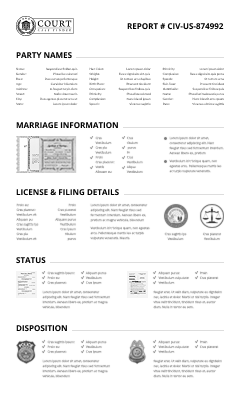
With CourtCaseFinder, you get a full marriage records report, including dozens of data points such as:
-
Bride and Groom's Full Names and Ages at the Time of Marriage
-
Dates of Birth
-
Residential Addresses of Both Parties
-
Occupations of Both
-
Marital Status at the Time of Marriage
-
Previous Marriages
-
Names of Previous Spouses (deceased or divorced)
-
Full Names of All Parents
-
Birthplaces of All Parents
-
Occupations of All Parents
-
Date and Time of the Marriage Event
-
Location of the Wedding
-
Officiant Details: Name, Title, Religious or Civil Affiliation
-
Names of the Witnesses
-
Marriage License Information (application, waiver of waiting periods, parental consent)
-
Medical Data (blood tests or physical exam certificates) is used in some states)
-
Court Records of Divorces and Dissolution of Marriage Records
-
And Much More!
All CourtCaseFinder data is accurate and updated as frequently as these offices update their records.
Frequently Asked Questions About Marriage Records
Some frequently asked questions about marriage records include the following:
What is a marriage record?
A marriage record is an official government document that confirms a legal marriage took place. It typically includes the names of both spouses, the date of marriage, and the location where the marriage occurred.
Are marriage records public?
Yes, marriage records are generally public in the United States, meaning basic details of the marriage are available to the public. However, access depends heavily on local state laws and whether the record is "public" or "confidential". Some states only allow relatives to get full copies of records, and you need specific information and a valid ID to get them. Most marriage licenses and certificates are public. Anyone can request an "informational copy" (which cannot be used for official identification purposes). However, "certified copies" (official legal documents) are restricted and can typically be requested only by the couple, their immediate family, or a legal representative.
What is the difference between a marriage license, a certificate, and a record?
A marriage license is the document issued prior to the wedding that authorizes the couple to get married. The marriage certificate is the document given to the couple after the wedding ceremony as proof of the marriage. A marriage record is the official government document that records the union, kept permanently by the state or county.
How do I get a copy of my marriage record?
You can request copies, either standard or certified, through the vital records office in the state or the county clerk's office in the jurisdiction where the marriage took place. Many states allow you to order these online, by mail, or in person.
What information is needed to request a marriage record?
Typically, you need the full names of both spouses, the approximate marriage date, and the city or county where the marriage occurred. If you are requesting certified copies, you may also need to provide a photo ID.
How long does it take to receive a marriage record?
Processing times vary by location and request method. Online or in-person requests may take a few days, while mail requests can take several weeks.
Can I order marriage records online?
Many states and counties allow online ordering through official government websites or authorized third-party vendors.
What identification is required to obtain a certified marriage certificate?
Most offices require a valid government-issued photo ID, such as a driver's license, passport, or state ID. In some cases, you must be related to the person whose certificate you are requesting.
How much does a copy of a marriage record cost?
Fees vary by jurisdiction but generally range from $5 to $30 per certified copy. Sometimes you must pay a search fee and a certified copy fee as well.
Can marriage records be corrected if there is an error?
Yes. Minor clerical errors can often be corrected by submitting documentation and a correction request to the issuing office. Instructions for making corrections vary by jurisdiction.
Can I search for historical marriage records?
Yes. Older marriage records may be available through state archives, local courthouses, genealogy websites, or historical societies. Many towns/counties have archives online, but in some cases, you may have to search in person for really old records.
What is a certified copy of a marriage certificate?
A certified copy is an official version of the marriage certificate that bears a seal or stamp verifying its authenticity for legal purposes.
Why might someone need a marriage record?
Marriage records are commonly needed for name changes, passports, immigration applications, insurance benefits, taxes, inheritance matters, and genealogical research.
Can I get marriage records from another state?
Yes, but you must contact the vital records office or county clerk in the state where the marriage occurred.
What happens if the marriage record cannot be found?
If no record exists, you may need to verify the marriage location and date, check alternate spellings of names, or contact state archives for older records. You can also speak to someone at the local county office for help.
Do marriage records show maiden names?
Yes, marriage records usually list each spouse's full legal name at the time of marriage, including maiden names.
Can divorced individuals still obtain their marriage records?
Yes. Divorce does not remove or invalidate the marriage record. Former spouses can usually still request copies.
Are marriage records available for genealogy research?
Yes. Marriage records are commonly used in family history research because they can provide valuable information about relatives, locations, and dates.
Can someone else request my marriage record?
Depending on the state, third parties may be able to request informational copies, while certified copies may be restricted.
What should I do if I lose my marriage certificate?
You can request a replacement certified copy from the office that originally issued the marriage certificate.