Instant Inmate Record Lookup
Inmate Info, Booking Info, Charges, Sentencing, Release Status, & More
- This Search is Secure and Confidential
- Last updated on October 23, 2026

Inmate Records
- Inmate Name
- Inmate ID Number
- Date of Birth
- Age
- Gender
- Race/Ethnicity
All Inmate Info
- Current Facility
- Facility Location
- Custody Status
- Housing Unit
- Admission Date
- Projected Release Date
All Inmate Details
- Primary Offense
- Charge Description
- Sentence Length
- Sentence Start Date
- Parole Eligibility Date
- Case Number
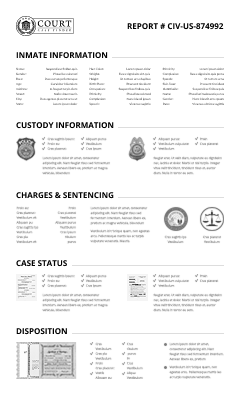
Providing Instant Inmate Records
for Over 12 Years

Instantly Search Full Inmate Record Information Online

View Inmate Record Info Including Booking Info, Charges, Sentencing, Release Status & More

View & Download Unlimited Comprehensive Inmate Reports
Inmate Records vs. Criminal Records *
Although people sometimes confuse the two, inmate records and criminal records are very different and serve different purposes. A criminal record tracks a person's legal history (charges and convictions), while an inmate record tracks a person's current or past housing status within a correctional facility (prison/jail/detention center).
Criminal Records
A criminal record (or "rap sheet") is a comprehensive history of an individual's interactions with law enforcement within the judicial system. It contains arrests, charges, court appearances, pleas, verdicts (guilty/not guilty), and sentencing. State bureaus, such as the state police, county courts, and federal agencies, create criminal records. Criminal records are often used during background checks for employment, housing, licensing, and security clearances. These records include convictions, so not all people with a criminal record have served time (many receive probation, fines, or have charges dismissed).
Inmate Records
An inmate record tracks exactly where and how an individual is or was incarcerated. It contains booking photos, facility locations, housing assignments, projected release dates, disciplinary reports, and visitation logs. State or federal Departments of Corrections or county sheriff's offices that manage jails create these records. The purpose of inmate records is to manage prison populations, track sentences, and allow the public to locate currently incarcerated individuals. These records cover only individuals who were sentenced to or held in a jail or prison.
Differences at a Glance
Feature |
Criminal Record |
Inmate Record |
|---|---|---|
Focus |
Legal history and case outcomes |
Custody status and facility location |
Content |
Arrests, trials, convictions, acquittals |
Prison ID, release date, transfers, housing |
Duration |
Permanent unless expunged or sealed |
Highly dynamic (changes based on parole/release) |
Accessibility |
Usually requires consent/fingerprints for full checks |
Generally public and easily searchable online via Department of Corrections portals |
How Inmate Records are Created and Processed
Inmate records are created during the initial booking process at an intake facility and are continuously updated throughout an individual's incarceration. They track housing, behavior, medical care, and release dates and may be used in legal or administrative matters.
1. Creation: The Intake & Booking Phase
An inmate's record begins the moment they enter a police station, county jail, or state department of corrections facility. Fingerprints are taken (often via digital LiveScan devices) and matched against federal and state databases to verify their identity. Mugshots are captured and attached to the file. Intake officers record demographic information, including name, address, phone number, emergency contacts, employment details, and Social Security numbers. A medical questionnaire and physical screening are conducted to document pre-existing conditions, medication needs, and any suicide or self-harm risks. All personal items are cataloged, and any physical cash is deposited into a secure inmate commissary account.
2. Processing: Compilation and Legal Documentation
Following the initial booking, the record is entered into the facility's Records Management System (RMS) or a state Department of Corrections (DOC) database. Legal documents such as court transcripts, sentencing orders, and pre-sentencing reports from the courts are permanently attached to the inmate's legal case file. Based on the severity of the offense, criminal history, and behavior during intake, corrections officials assign the inmate to an appropriate custody or security level within the facility. For state and federal inmates, administrative data are standardized and submitted to tracking systems such as the Bureau of Justice Statistics.
3. Maintenance: Daily Tracking and Updating
An inmate's record is not static; it requires constant updates as the individual serves their sentence. Each event during their incarceration is documented and added to the file. Corrections officers continually update pod logs with headcounts, movement, visitor lists, and disciplinary infractions. Any injuries, medication passes, or hospital visits are documented in a separate, confidential medical case file. Inmate records departments dynamically calculate release dates by subtracting credited jail time and applying "good conduct" or statutory reduction rules.
4. Access and Retrieval
How these records are accessed depends entirely on the requester and state/federal open records laws. Basic information like housing location, admission date, and projected release date is generally accessible to the public via online inmate locators (e.g., the Federal Bureau of Prisons Locator). Federal and state repositories maintain comprehensive criminal histories used by the courts and law enforcement agencies. Individuals seeking their own "rap sheet" or summary of criminal history can request it through authorized procedures by paying processing fees, such as submitting an Identification Record request to the FBI CJIS Division.
How to Access Inmate Records
Performing an inmate search depends on whether you are looking for the current incarceration status or historical criminal records. The process varies by jurisdiction, but to look up an inmate in jail, you generally must use a state online locator or court portal, or file a formal public records request.
Inmate Locator Resources
-
State & Federal Online Locators: The public can look up someone's current incarceration status for free. For federal inmates, use the Federal Bureau of Prisons (BOP) Inmate Locator. For state prisons, visit your state's Department of Corrections website.
-
County & Local Jails: If the individual is held in a county jail rather than a state prison, use local facilities. For example, local county resources offer online search tools, lobby kiosks, and phone directories.
-
Court Records: Case files, trial details, and sentencing documents are public records. Federal court dockets can be searched using the Public Access to Court Electronic Records (PACER) system. For state-level court cases, check the state's judicial branch portal.
-
Formal Records Requests: For official, certified criminal history or documents not available online, submit a formal records request under your state's Right-to-Know law.
-
CourtCaseFinder: An efficient way to look up inmate records and find criminal histories, inmate records, and court documents, all with one quick and easy search.
What Information Can You Find in Inmate Records?
Inmate records typically contain identifying details, official legal charges, incarceration status, and facility logistics. The exact data available varies by the governing agency (e.g., federal, state, or county jail).
The detailed table below outlines the standard information generally found in public inmate records:
Feature |
Details |
|---|---|
Inmate Name |
The official legal name, including middle names or suffixes. |
Inmate ID Number(s) |
Unique identification codes (e.g., DOC number, Bureau of Prisons number, or State/County ID). |
Date of Birth |
The inmate's birth date, used to verify their identity. |
Physical Descriptions |
Includes race, gender, height, weight, hair color, and eye color. |
Current Facility |
The specific prison, jail, or correctional facility where the inmate is housed. |
Custody Level / Security |
The assigned security classification (e.g., minimum, medium, maximum, or administrative segregation). |
Incarceration Status |
The current status (e.g., Incarcerated, Paroled, Escaped, or Transferred). |
Charges / Offenses |
The specific statutes, crimes, or offenses for which the inmate was convicted. |
Case / Docket Number |
The official court record identifier for the specific criminal case. |
Sentence Length |
The total duration of the sentence handed down by the court. |
Admission Date |
The date the inmate was officially booked into the correctional system. |
Projected Release Date |
The estimated date of release, which is subject to change based on parole hearings or behavior. |
Why Search for Inmate Records
People search for inmate records for various reasons, such as locating a family member, conducting legal or employment background checks, or pursuing historical/genealogical research. Victims of offenders also search for release dates. Official public databases provide transparency, allowing citizens to monitor court dates, confirm bail statuses, and ensure the well-being of incarcerated individuals.
Common scenarios for conducting an inmate search include:
-
Family and Support Network Communication: Loved ones use inmate locators to find the exact facility where a person is housed so they can arrange visits, send mail, or deposit funds into the inmate's commissary account.
-
Victim Notification and Safety: Victims and concerned citizens use real-time offender-tracking databases to check whether an aggressor is still in custody, monitor pending court dates, or receive alerts about upcoming release dates.
-
Legal and Court Preparation: Defense attorneys, bondsmen, and court officials look up booking numbers, current charges, and bail or bond conditions to facilitate client representation and manage court appearances.
-
Pre-Employment Screening: Employers, particularly in security, education, and healthcare, check conviction histories as part of standard background screenings to assess candidate suitability and ensure workplace safety.
-
Financial and Debt Recovery: Debt collectors and civil process servers use incarceration records to determine if an individual is currently uncollectible or to find their current institutional address.
-
Genealogical or Historical Research: Genealogists and historians access archived prison logs and registers to trace family trees, understand historical crime rates, or investigate ancestral medical records.
-
Journalism and Civil Advocacy: Investigative reporters and policy advocates search records to analyze systemic trends, investigate prison conditions, and ensure that the justice system operates fairly.
How Far Back Do Inmate Records Go?
Inmate and criminal records can go back indefinitely, but how far back you can view them heavily depends on the database, state laws, and the type of background check being conducted.
State and federal criminal histories often span a person's entire lifetime unless legally expunged or sealed. For example, the Federal Bureau of Prisons (BOP) provides access to records for federal inmates released after 1982, while older historical records dating back to 1870 are kept by the National Archives and Records Administration (NARA).
The federal Fair Credit Reporting Act (FCRA) generally restricts commercial background screening companies from reporting arrests that did not result in a conviction after 7 years. However, the seven-year rule typically does not apply to criminal convictions, and many states have no time limits for reporting convictions.
How Long Does It Take to Find Inmate Records?
Finding basic, current inmate records online usually takes 1 to 24 hours after booking. However, official background checks, historical documents, or federal sentencing can take anywhere from a few days to 60 days.
The exact timeline depends on the specific database and your search method.
Standard Inmate Locators (Current Status)
-
Online County/City Jails: Usually updated within 1 to 24 hours following an arrest and booking.
-
State Departments of Corrections: Typically takes 24 to 48 hours (or sometimes until the inmate is transferred to a permanent facility) to appear in state databases.
-
Federal Bureau of Prisons (BOP): Usually updated within a few hours to a day of arrival. However, federal sentence computations can take up to 60 days.
-
Third-Party Notifications: Using systems like CourtCaseFinder provides near-instant status changes once the facility processes the inmate.
Official Records and Background Checks
-
Online State Criminal History Requests: Results are typically generated instantly to 1 business day, though complex reviews can push processing times to a week.
-
National Archives (Historical Records): Locating prison records predating 1982 or older archives through USAGov requires a formal records request and can take several weeks.
Keep in mind that several factors can cause delays. For example, if an inmate is moving between a local jail and a state/federal prison, the system might show them as "in transit" with temporarily unavailable details. Records for juvenile offenders or those held in protective custody may not be publicly accessible. Rural or understaffed county facilities might update their online rosters manually just once a day.
Why Use CourtCaseFinder for Inmate Records
Searching inmate records manually can be time-consuming and frustrating, especially if you don't know where the person is incarcerated. It can be difficult to locate the correct facility where the files are located or the online portal to search. Although many are available online, you might need to visit the local county courthouse/jail/prison in person to obtain records.
CourtCaseFinder offers a much better solution, putting millions of records at your fingertips instantly. With a single search, you can pull data from multiple sources and aggregate it into a nice, easy-to-read report that contains everything you need. The data comes directly from prisons, jails, court offices, local city/county records offices, and other government sources. In most cases, data is updated daily or weekly, depending on the state's reporting schedule and the specific court type, and will match what you can find there.
Because CourtCaseFinder combines records from multiple sources, you don't have to hunt to find the right portal. With a single search, you can find all the records pertaining to that inmate.
Searching county online portals may offer a free search option, but you may be limited in what you can find, and you won't be able to print, download, or order certified copies. Other limitations include restricted access to sensitive case types, incomplete older records, and, ultimately, the need to visit the court or jail in person for the full documentation.
With CourtCaseFinder, you get a full inmate records report, including dozens of data points such as:
-
Inmate Name (including middle name, suffixes, or aliases)
-
Date of Birth
-
Inmate Number/ID
-
Physical Description (including scars and tattoos, race, gender, height, weight, hair color, and eye color).
-
Current Facility: The specific prison, jail, or correctional facility where the inmate is housed.
-
Custody Level/Security (e.g., minimum, medium, maximum, or administrative segregation).
-
Incarcerated Status (e.g., Incarcerated, Paroled, Escaped, or Transferred).
-
Charges/Offenses: The specific statutes, crimes, or offenses for which the inmate was convicted.
-
Case Number/Docket: The official court record identifier for the specific criminal case.
-
Sentence Length: The total duration of the sentence handed down by the court.
-
Admission Date: The date the inmate was officially booked into the correctional system.
-
Projected Release Date: The estimated date of release, which is subject to change based on parole hearings or behavior.
-
And Much More!
All CourtCaseFinder data is accurate and updated as frequently as these offices update their records.
Frequently Asked Questions About Inmate Records
What are inmate records?
Inmate records are official documents containing information about individuals who are or were incarcerated in a jail, prison, or correctional facility. They differ from criminal records in many ways.
Is it legal to search for inmate records?
Yes, you can easily search for public information on inmates incarcerated in county, state, and federal prisons without violating any laws.
Are inmate records public?
In many cases, inmate records are considered public information, though access may vary depending on state laws, federal regulations, and privacy restrictions. In some cases, you may see more information, and in others, less.
How can I look up an inmate in jail?
You can search through county jail websites, state Department of Corrections databases, or federal inmate locators using the inmate's name or identification number.
What information is included in inmate records?
Records may include the inmate's full name, booking date, charges, mugshot, sentence length, facility location, release date, inmate ID number, and custody status.
Can I search for federal inmates online?
Yes. The Federal Bureau of Prisons provides an online inmate locator for federal prisoners. The website is fairly easy to navigate.
What is the difference between jail and prison inmate records?
Jail records usually involve short-term detention or pretrial inmates, while prison records relate to individuals serving longer sentences after conviction. Sometimes you can search for both types using the same resource.
How often are inmate records updated?
Most online inmate databases are updated daily, though update frequency depends on the correctional facility or agency maintaining the records. Whenever a new event occurs in the inmate's life, it gets recorded and added to the file.
Can I find an inmate's release date?
In many jurisdictions, estimated or scheduled release dates are available through inmate records unless restricted for safety or legal reasons.
Are mugshots included in inmate records?
Many inmate records include booking photographs, though some states have restricted public access to mugshots. Rules on mugshots vary widely by jurisdiction.
Can juvenile inmate records be accessed?
Typically, no. Juvenile records are usually sealed or restricted to protect the privacy of minors.
What should I do if I cannot find an inmate online?
The inmate may have been recently transferred, released, booked under another name, or held in a facility that does not publish records online.
Can inmate records be removed or sealed?
In some cases, records may be expunged, sealed, or restricted by court order, depending on state laws and the nature of the offense. Typically, however, most are considered public record.
Is there a fee to access inmate records?
Basic inmate searches are often free, but certified copies, archived records, or detailed reports may require payment.
Can I contact an inmate through information in the records?
Inmate records may provide facility contact information, mailing instructions, or visitation details, but direct personal contact information is not disclosed.
Why might inmate records contain incorrect information?
Errors can occur due to data entry mistakes, delayed updates, aliases, or outdated information. Individuals can usually request corrections through the correctional agency.