Instant UCC Filings Lookup
Debtors, Creditors, Collateral, Filing Info, Status, & More
- This Search is Secure and Confidential
- Last updated on October 23, 2026

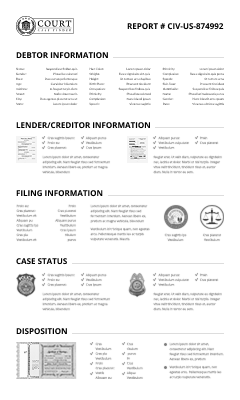
UCC Filing Records
- Debtor Name
- Debtor Type
- Debtor Address
- Debtor State
- Entity Number
All UCC Filing Info
- Filing Date
- Filing Number
- Filing Type
- Filing Status
- Expiration Date
All UCC Filing Details
- Secured Party Name
- Secured Party Address
- Collateral Description
- Collateral Type
- Amendment History
Providing Instant UCC Filing Records
for Over 12 Years

Instantly Search Full UCC Record Information Online

View UCC Filing Info Including Debtor, Lender, Filing Status & More

View & Download Unlimited Comprehensive UCC Filing Reports
What Are UCC Filings? *
A Uniform Commercial Code (UCC) filing is a legal notice that a lender files to publicly claim a security interest in a borrower's business assets. It serves as written proof that assets such as inventory, equipment, or accounts receivable are being used as collateral for a loan and are therefore not available to secure additional financing.
Banks, lenders, and others file these notices as public records to alert other creditors that an asset is already pledged as debt, establishing the order of who gets paid first if the business defaults or declares bankruptcy. The "first-to-file" rule states that generally, the first creditor to file the UCC form gets the first claim to the collateral.
UCC filings are linked to liens, which specify which collateral is covered. They can be specific and limit the claim to designated pieces of property (e.g., a single piece of heavy machinery), or use "all assets" language, which refers to a blanket lien that gives the lender rights to almost all of the debtor's current and future business assets. This is highly common for business lines of credit and term loans.
How UCC Filings Are Created and Processed
A UCC filing is a legal, public notice that a lender uses to claim a borrower's assets (collateral) for a secured loan. It publicly establishes the lender's priority for repayment if the borrower defaults, essentially acting like a mortgage on personal property.
The process involves five main steps:
1 - Preparing the Form
Once a borrower signs a security agreement granting collateral for a loan, the lender prepares a UCC-1 financing statement. This short, standardized form generally only requires three pieces of information:
-
Debtor Details: The exact legal name and address of the borrower.
-
Secured Party Details: The lender's name and address.
-
Collateral: A description of the assets securing the loan (e.g., all business assets, accounts receivable, or specific equipment).
2 - Choosing the Filing Office
Where the form is filed depends entirely on the type of debtor and collateral. For a business or individual, most standard business and personal property filings are submitted to the Secretary of State (or equivalent agency) in the state where the business is registered, or where the individual resides. If the collateral is permanently attached to land (like a fixture, timber, or minerals), the form is usually filed in the local county recorder's office (or similar agency).
3 - Submission and Processing (Perfecting)
Lenders generally submit these forms online through state portals, though paper filings by mail or fax are still an option in some areas. The filer must pay a standard filing fee. State offices process and "index" the document into their public database, which typically takes 24 to 48 hours. Once recorded, the lien is officially active and "perfected".
4 - Public Notice and Priority
The filed UCC-1 becomes part of the state's public records, allowing anyone (such as other banks, equipment suppliers, or future creditors) to search the debtor's name and see exactly what property is already encumbered by debt. This system dictates priority: the first creditor to properly file and record their UCC-1 generally gets "first in line" for repayment if the borrower fails financially.
5 - Maintenance and Release
A standard UCC filing automatically expires after five years. If the loan is still active, the lender can file a UCC-3 continuation form within the last six months of the fifth year to renew their claim. Creditors must file a UCC-3 continuation statement within the 6-month window before the 5-year expiration to maintain their lien priority. Typically, lenders can file as many UCC-3 continuation forms as needed until the loan is paid off.
Once the loan is paid in full, the lender is legally required to file a UCC-3 termination statement. This officially cancels the public claim on the borrower's assets and removes the lien from their record.
What UCC Forms are Used, and What Do They Do?
-
UCC-1 (Financing Statement): The initial legal form used to formally record a security interest or lien.
-
UCC-3 (Amendment/Continuation/Termination): A multi-purpose document used to alter, renew, or close an existing UCC-1.
Where do I file a UCC Financing Statement?
UCC filings are generally filed at the Secretary of State's office in the state where the debtor is located or incorporated. If the collateral involves real estate, fixtures, minerals, or timber, the filing is typically submitted to the local county office (e.g., the register of deeds or county recorder's office).
What Kind of Data is Revealed in UCC Filings Lookup?
A UCC lien search will reveal active and historical liens placed on a business's or individual's assets, usually to secure a loan. Lenders and investors use these records to evaluate outstanding debt, assess risk, and determine who holds the primary claim on specific collateral.
A standard UCC search report provides the following data points:
-
Debtor Details: The official legal name and address of the person or business that pledged the asset.
-
Secured Party Information: The exact name and address of the lender or creditor holding the security interest.
-
Collateral Description: A written description of the assets used to secure the debt. This can range from specific equipment and inventory to broad, company-wide "all assets" blanket liens.
-
Filing Dates: The original filing date and any dates related to subsequent amendments or continuations, which establish the priority of the lien.
-
Filing Numbers: The state-assigned document reference numbers used for tracking and auditing trails.
-
Filing Status: Indicates whether a filing is currently active, amended, continued, or terminated
How to Access UCC Filings with a UCC Lien Search
The process for performing a UCC filing lookup will vary slightly by state, as different agencies, each with its own search portal, maintain these records. Your basic options for conducting a UCC lien search include searching online via the state portal, which displays non-certified results (adequate for preliminary searches). You can also mail in your request and pay a fee for certified results (which are required for legal and financial matters). You can also find UCC filings through an authorized search service like CourtCaseFinder, where all state and county records are aggregated to make searching quicker and easier.
The general process of searching for UCC filings is as follows:
-
Identify the Filing State: For registered business entities (such as LLCs or corporations), search the state where the business is officially organized. For individuals, search in the state where they reside. If you need to find state portals, use the NASS State UCC Filings Directory to locate the exact office.
-
Identify the Debtor's Exact Legal Name: Most state portals are very strict about name-matching. You must enter the debtor's exact legal name (from their business formation documents or driver's license); otherwise, you may miss crucial filings and active liens. These systems do not use any fuzzy matching, and even a small variation like a missed comma, middle initial, or even a DBA abbreviation can skew your search results.
-
Access the State's Search Portal: Navigate to the UCC division of the SOS website. Some states require a free user account to run a search, while others allow completely free, public name searches. You can also use CourtCaseFinder to run unlimited searches.
-
Choose Your Search Criteria: You can search by Debtor Name, Document Number, or Secured Party Name. Some portals offer additional options to narrow down your search.
-
Review the Results and Request Copies: Carefully review the results to ensure it's the correct debtor, secured party, and collateral. Check lapse dates, search for UCC continuations or terminations, and note any assignments (in which the original secured party transfers the lien to another entity). Standard online searches will generally give you a list of active or lapsed UCC filings. Non-certified results are only good for basic research and preliminary due diligence. You will need certified copies for legal matters, real estate deals, and other official purposes. If you need official or certified copies of the filing documents, you will typically need to submit a request (using a UCC-11 form) and pay a small fee.
In What Cases Do You Need a UCC-1 Filings Search?
Most often, a UCC-1 filing search is used during financial due diligence to prevent multiple lenders from issuing loans against the exact same collateral without proper priority. A UCC filing lookup helps to assess risk before lending money, purchasing a business, or extending credit. It verifies who has the first claim to assets in the event of a default. Some specific use cases for a UCC-1 filings search are:
Before Extending Credit or Issuing a Loan
If you are a lender or a business that provides equipment financing or large lines of credit, a UCC search ensures that the borrower's collateral is not already pledged to another creditor. It helps secure your priority, as the "first to file" typically gets the first claim to the assets if the debtor defaults.
Mergers, Acquisitions, or Buying Assets
Before purchasing a company or its physical assets, buyers run a UCC search to identify any hidden liabilities. You want to know exactly what you are absorbing, so you do not unknowingly purchase a company whose assets are tied up in another creditor's lien.
Corporate Due Diligence
Attorneys and accountants regularly run UCC searches to assess the financial health of a prospective client, vendor, or partner. It provides transparency into a company's debt load and reveals if there are any existing tax liens or judgments filed against its property.
Verifying Your Own Status
As a lender, you may run periodic searches to verify that your own UCC filings remain active, have the correct debtor's name, and are properly recorded in the correct jurisdiction. As a debtor, you may check to ensure that a lien has been released properly before applying for additional funding.
What are the Different Types of UCC Filings?
Under the Uniform Commercial Code, collateral refers to any personal property or asset a borrower pledges to a lender to secure a loan or lease. UCC filings protect lenders by legally establishing their priority claim to these assets. Some examples of these assets are as follows:
Tangible Assets
These are physical, movable items used for business operations or held for sale.
-
Equipment: Machinery, computers, vehicles, tools, and office furniture.
-
Inventory: Raw materials, work-in-progress, and finished goods held for sale or lease.
-
Farm/Agricultural Products: Crops, livestock, or supplies used in a farming operation.
-
As-Extracted Collateral: Timber, minerals, and gas products (attached to the land).
-
Consumer Goods: Products bought or used primarily for personal, family, or household purposes.
Intangible Assets and Quasi-Goods (Paper/Rights)
These are assets that have value on paper, represent a right to payment, or have no physical form.
-
Accounts Receivable: Unsecured rights to payment for goods or services sold or leased on credit.
-
Instruments & Investment Property: Negotiable promissory notes, stocks, bonds, and certificates of deposit.
-
Chattel Paper: Records (electronic or tangible) that show both a monetary obligation and a security interest in specific goods (e.g., equipment leases).
-
General Intangibles: Residual category for intangible assets, which includes intellectual property (patents, trademarks, copyrights), software, goodwill, and payment intangibles.
-
Commercial Tort Claims: Rights to claim monetary damages arising from business-related wrongs.
How Far Back Do UCC Records Go?
Uniform Commercial Code records typically date back to the mid-1950s, which is when states first began adopting the UCC. While the active lifespan of a single, continuous UCC-1 filing is generally just 5 years (unless extended via a continuation statement), the historical or archival databases in many state registries hold records stretching back decades. However, this varies widely by state. Some states keep records for years, and others discard them after a specific timeframe.
Some of the factors that govern how far back these records go are:
-
Active vs. Lapsed Records: Most states only allow you to view active and recently lapsed records (usually ranging from 1 to 7 years post-lapse) in their current online search databases.
-
State Archiving Practices: If you need to search for historical or terminated UCC filings from the 1970s or 1980s, you often have to submit a formal historical search request to the specific state's Secretary of State office or archive facility.
-
Exceptions to the 5-Year Rule: While most standard commercial filings last for 5 years, certain filings can extend much further back without requiring a continuation. For example, public finance transactions and manufactured-home liens remain active for 30 years, and transmitting utility filings are perpetual.
-
Transition to Digital: Records from before the 1990s might not be available digitally. You may need to request physical microfiche or paper document pulls directly from the filing jurisdiction.
How Long Does It Take to Find UCC Filings?
Finding existing UCC filings takes a few seconds to a few minutes if you search online. Results for active filings are public and typically accessible immediately through your state's Secretary of State website or a third-party corporate service like CourtCaseFinder. The amount of time depends heavily on whether you have the correct debtor's name, the search portal you are using, and your method. If you request records by mail, it can take up to three business days.
Why Use CourtCaseFinder for UCC Filings
Although many UCC filings are recorded with state Secretary of State offices, some states have specific agencies to handle these records. Fixture filings, federal tax liens, and other property-related filings get recorded at the county level, making searches more complex and cumbersome. If you don't search all relevant databases, you could miss critical filings. CourtCaseFinder simplifies UCC lien searches by combining the data from state and county resources, allowing you to enter a debtor name and see all related filings and liens.
Manual searches take time and often money. To perform proper due diligence, you must thoroughly search all locations, which can be time-consuming and confusing, yet still yield inaccurate results. CourtCaseFinder offers a better, faster solution by combining state, county, and federal data and allowing you unlimited searches. Using a single search string, you get the right information at your fingertips when you need it, without the hassle of going through the dozens of state and county offices. All CourtCaseFinder data is accurate and updated as frequently as these offices update their records.
Frequently Asked Questions About UCC Filings
Some frequently asked questions about UCC filing searches and records include:
Are UCC filings public records?
Yes, Uniform Commercial Code filings are public records, and it is entirely legal for anyone to search for them. Filed at the state level (usually through the Secretary of State), they are maintained to give creditors public notice that another party has a financial interest or claim on a debtor's assets, typically acting as collateral for a commercial loan.
What is a "termination", and can a debtor file one?
A termination statement is filed by the secured party (creditor) once the debt has been paid in full to cancel the lien. If the loan is paid but the creditor refuses to file a termination, the debtor can submit a UCC-3 termination statement themselves, though state-specific rules apply to this timeframe.
Why do UCC filings get rejected?
Filings are often rejected due to minor but strict errors, including an incorrect debtor name. The debtor's name must perfectly match their government-issued ID or the organization's public organic record (e.g., typos, missing middle names, or using the Trustee's name for a trust). Another reason is missing information, such as incomplete addresses or missing filing fees. Sometimes, the debtor and the secured party appear to be the same individual or entity, and the state may reject the claim on that basis.
How much do UCC filings cost?
Filing fees are set at the state or county level. Most jurisdictions charge a nominal base fee in the range of $10 to $25, though these fees can fluctuate or multiply depending on how many individual debtors are listed on a single form. Some offices charge a per-page fee plus certification and search fees. To verify your specific filing fees, check with the local jurisdictional requirements, or access state-specific forms. Visit the National Association of Secretaries of State to find your direct state filing office.
What is a UCC-1 financing statement?
A UCC-1 is the most common UCC filing. It is filed to notify other creditors that a lender has rights to specific collateral if the borrower defaults.
Who files a UCC-1 statement?
Typically, the lender or secured party files the UCC-1 after issuing a loan secured by assets. They do this to "perfect" their interest and tag their place in line in the event of a default or bankruptcy.
Where are UCC filings made?
Most UCC filings are submitted through the Secretary of State's office in the borrower's state of incorporation or residence. Some states have other dedicated offices that handle these records.
What types of collateral can be listed in a UCC filing?
Collateral may include equipment, inventory, accounts receivable, vehicles, fixtures, intellectual property, or even all business assets.
What is the difference between specific collateral and blanket liens?
A specific lien covers designated assets only, while a blanket lien covers nearly all business assets. The term "All assets" can refer to both current assets and new assets acquired after the lien was imposed.
How long does a UCC filing remain active?
Most UCC-1 filings remain effective for five years unless continued, terminated, or amended. Mobile home UCC filings generally last for 30 years. UCC filings for utility assets and other assets may also have different lifespans.
What is a UCC-3 filing?
A UCC-3 is used to amend, continue, assign, or terminate an existing UCC filing. It is a multi-purpose form used for a variety of purposes.
How do I remove a UCC filing?
Once the debt is satisfied, the secured party should file a UCC-3 termination statement to release the lien. If they do not, you can follow your state's instructions to file one yourself.
Can a UCC filing affect my business credit?
Yes. Existing UCC liens may affect a company's ability to obtain additional financing because they indicate that the company has secured debt. They can actually block new loans and credit, which is why a UCC-3 termination filing is so crucial.
Can multiple lenders file UCC liens on the same business?
Yes, but lien priority generally depends on the order in which filings were made.
What happens if a borrower defaults?
The secured lender may repossess or seize the collateral identified in the filing, subject to applicable laws.
What happens if there is an error on a UCC filing?
Errors, especially in the debtor's legal name, can make the filing ineffective or challengeable. Most states have very strict name filing rules.
What is lien priority in UCC filings?
Priority determines which creditor gets paid first if assets are liquidated. Usually, "first to file" has priority.
Do UCC filings apply to real estate?
Generally, UCC filings cover personal property, not real estate, though fixture filings can relate to attached property. This also applies to "as extracted" items and other things directly related to the property itself.
What is a purchase money security interest (PMSI)?
A PMSI is a special type of secured interest that gives certain lenders priority when financing the purchase of specific goods. A PMSI can leap ahead of other, older UCC filings in terms of priority. That is why a UCC filing lookup is so essential.
Can a UCC lien prevent me from selling assets?
Potentially yes, because the lender's security interest may follow the collateral until it is released. This comes into play during co-op apartment purchases and other deals.
What's the difference between secured and unsecured loans in relation to UCC filings?
Secured loans usually involve UCC filings because collateral is pledged; unsecured loans generally do not.
What is "perfection" in UCC law?
Perfection is the legal process of establishing and protecting a lender's claim against collateral, often through filing.